For mobility retailers, customer visits are a critical driver of revenue. Yet inconsistent experiences across a retail network can weaken customer preference and discourage repeat visits. Simon-Kucher's AI-powered Noise-to-Market model helps retailers identify where sites are falling short of customer expectations and prioritize the improvements that matter most.
What drives revenue growth at a fuel retail site? Pricing, location, and visibility are obvious considerations. Yet a recent Simon-Kucher big data project with a European fuel retailer found that the number of customer visits was the most important factor in explaining fuel revenue performance, followed by price differential.
The finding has significant implications for how retailers manage their networks. Increasing visit frequency means giving customers more reasons to choose a particular site, including occasions when they may have no immediate need to refuel or recharge their car.
A compelling convenience store offer can help make a site a destination in its own right. Quality coffee, fresh bread, and other complementary products create additional reasons to visit.
The same principle applies to electric vehicle (EV) charging. Research from Next 10 and UC Davis found that EV drivers were 37% more likely to choose a charging station offering additional amenities, such as restrooms and convenience stores.
For fuel retailers, the opportunity extends beyond increasing nonfuel sales. A customer who regularly visits a site for hot drinks or convenience purchases may also be more likely to choose that location when refueling.
The commercial challenge is to deliver an experience that consistently earns those visits.
A strong offer at a flagship location can attract customers and establish expectations for the wider brand. When other sites fail to meet those expectations, the resulting disappointment often undermines customer preference.
Our Noise-to-Market (N2M) framework helps retailers identify where that promise is breaking down. The N2M was initially developed by the Global centre of Excellence for Restaurants
How inconsistent site execution creates Noise-to-Market
Customers expect a recognizable experience across locations operating under the same brand. They may encounter excellent service and clean facilities at one station, then experience poorly maintained restrooms or unhelpful staff at another.
Each experience shapes their perception of the brand and their willingness to return.
Consider a customer who chooses a fuel retailer because of its reputation for quality facilities. After encountering an unclean restroom at one location, the customer leaves a negative review expressing disappointment that the site failed to meet the brand's usual standards.
The underlying issue is a gap between what the customer expected and what the location delivered.
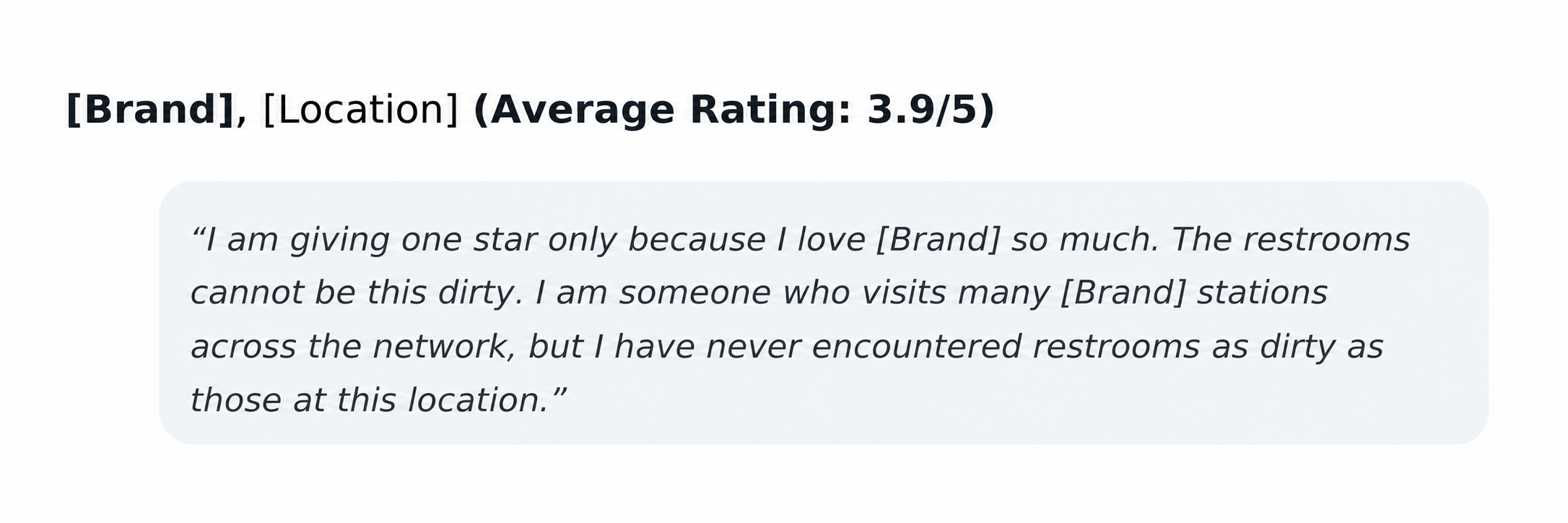
A single poor site experience can undermine expectations established by the wider retail network.
Simon-Kucher's N2M framework measures this type of disappointment using customer feedback from publicly available review platforms such as Google and Tripadvisor.
The model uses AI to analyze individual written comments and assign each a noise score reflecting the level of disappointment expressed by the customer. These scores provide a more granular view of customer experience across the retail network.
A site with high noise may be falling short because of issues within local management's control. Other concerns, particularly those relating to perceived value for money, may reflect broader pricing or commercial decisions.
Identifying the source of dissatisfaction helps retailers determine where corrective action is needed and who should take responsibility.
From brand tracking to site-level insight
Retailers already have access to substantial performance data. Brand trackers measure overall perception, while transaction reports show commercial results. NPS surveys, operational KPIs, and competitor benchmarks provide additional perspectives.
These measures can leave important gaps in understanding how customers experience individual locations.
A network may perform well overall while a relatively small number of sites consistently disappoint customers. Aggregate brand measures can make these local problems difficult to detect.
N2M helps close that gap by connecting customer perceptions with the performance of individual sites. It enables retailers to identify locations with similar challenges and group them into micro-clusters based on customer feedback and competitive conditions.
These clusters can reveal whether customer dissatisfaction is associated with local execution, such as restroom cleanliness or staff behavior, or with issues requiring broader commercial intervention.
For management, this allows a more targeted response. A network-wide initiative may be unnecessary when the underlying problems are concentrated in a handful of locations.
By identifying where expectations are being missed, retailers can focus attention on the sites and issues most likely to benefit from corrective action.
Identify where customer value perceptions are breaking down
One application of N2M is to assess perceived value for money alongside customer satisfaction with the wider site experience.
The model can distinguish dissatisfaction related to price from disappointment with other aspects of the offer, including facilities, service quality, and staff friendliness.
Plotting these dimensions at site level reveals differences that conventional network reporting may overlook.
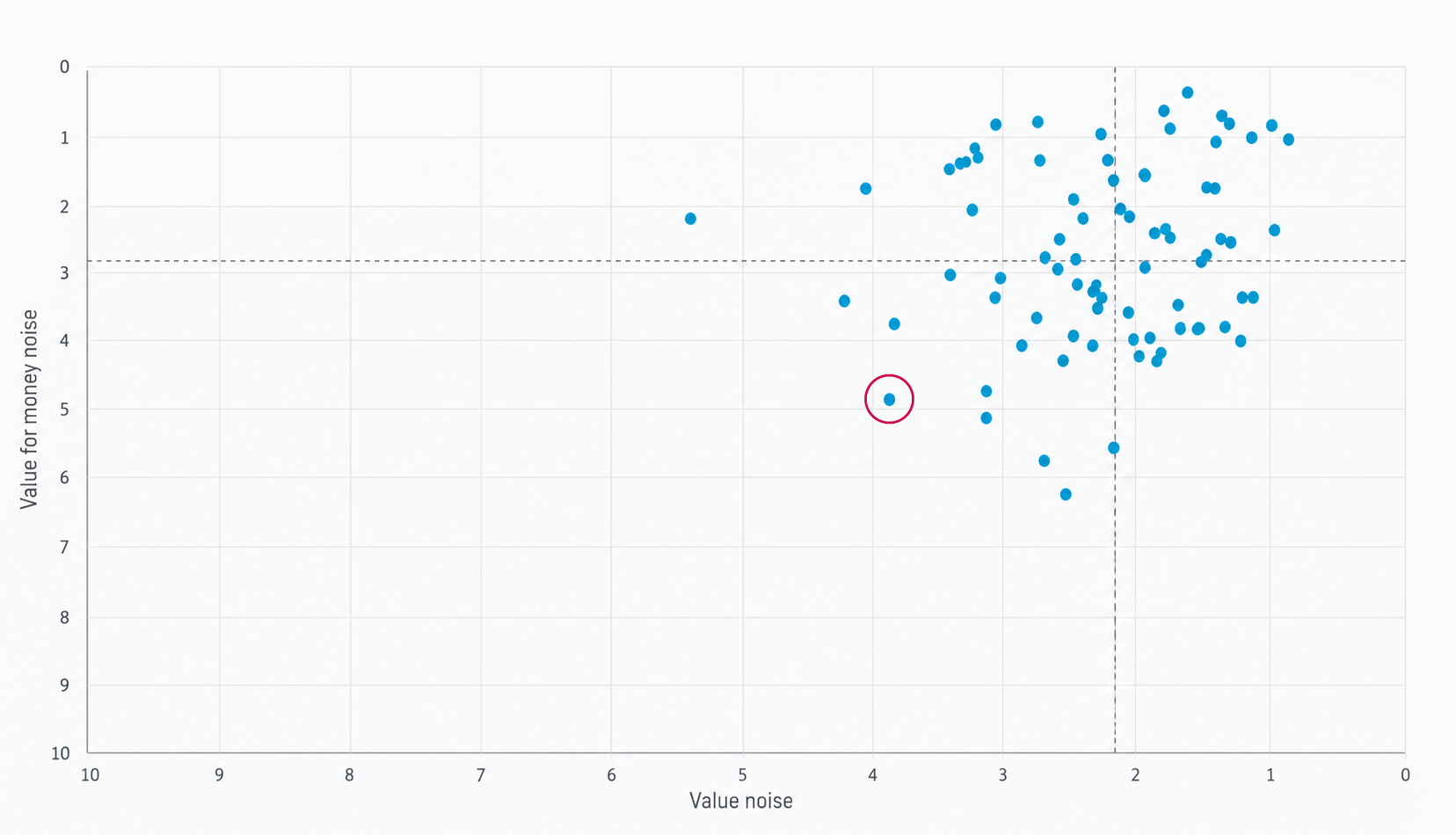
Most locations in this European fuel retailer's network perform well, while a smaller group generates disproportionate customer disappointment that may be difficult to identify through aggregate brand tracking. The encircled station is a brand detractor creating noise against expectations both from a quality and value for money perspective. Here it is likely that the price differential to competition needs to be lowered and some onsite measures are required to improve the customer on-site experience.
For leadership teams, this analysis helps answer an important question: Is weakening customer perception a network-wide issue, or is it being driven by specific locations?
The answer should influence the response.
A location experiencing repeated complaints about cleanliness may require closer operational oversight. A site with strong service ratings but persistent value-for-money concerns may warrant a review of its local pricing position.
N2M provides a basis for investigating these differences and directing management attention accordingly.
Track whether customer perceptions are improving
Because N2M draws on written customer reviews, retailers can also monitor changes in noise over time and compare performance with competitors.
This helps management assess whether customer disappointment is increasing and which locations are contributing to the trend.
In the European fuel retailer example, the network performed above the market average overall, yet customer noise was increasing relative to competitors. The deterioration was associated with a small number of underperforming sites.
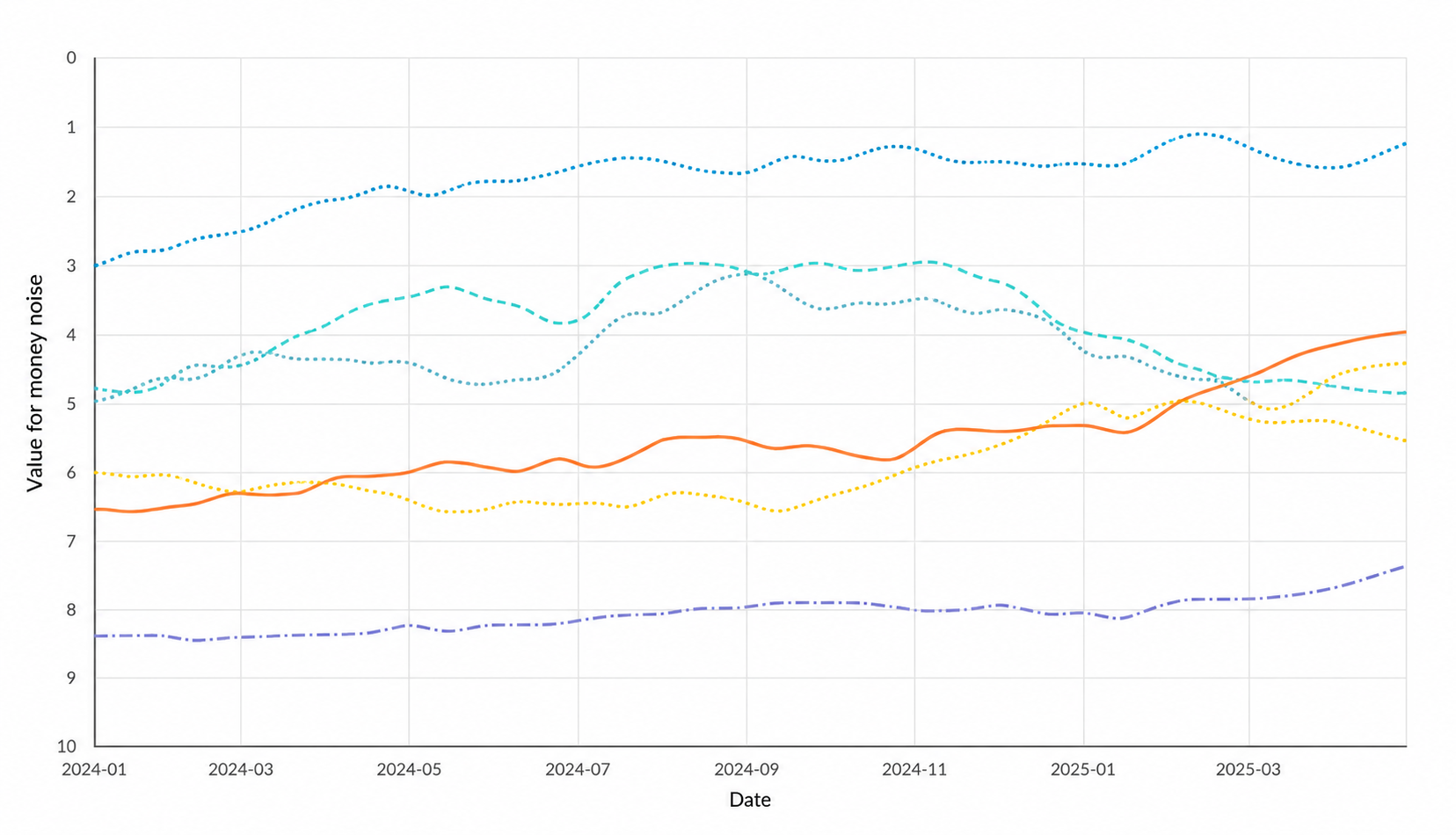
A retailer can perform above the market average while experiencing rising customer disappointment associated with a small number of underperforming locations. The orange Retail fuel brand has continuously worked with its underperforming stations improving its value-for-money perception in the market.
A broad program to improve customer experience across every site may absorb considerable resources without addressing the locations responsible for the greatest dissatisfaction.
A more targeted approach starts by identifying which sites are deteriorating, understanding the issues behind their scores, and assessing the actions required.
Tracking noise over time also provides a way to monitor whether customer perceptions improve following intervention, although changes in review volumes and customer mix need to be considered when interpreting results.
Turn customer feedback into clear operational priorities
The practical value of N2M lies in translating customer feedback into specific actions for site managers and field teams.
Because reviews are linked to individual locations, retailers can create performance leaderboards that highlight sites with the highest levels of customer disappointment.
The accompanying review analysis helps explain what is driving each site's score.
For example, one of the lowest-performing locations in the original analysis received complaints about rude or absent staff and a car wash that was not functioning properly.
These are tangible operational problems that a field-based account manager can investigate and address.
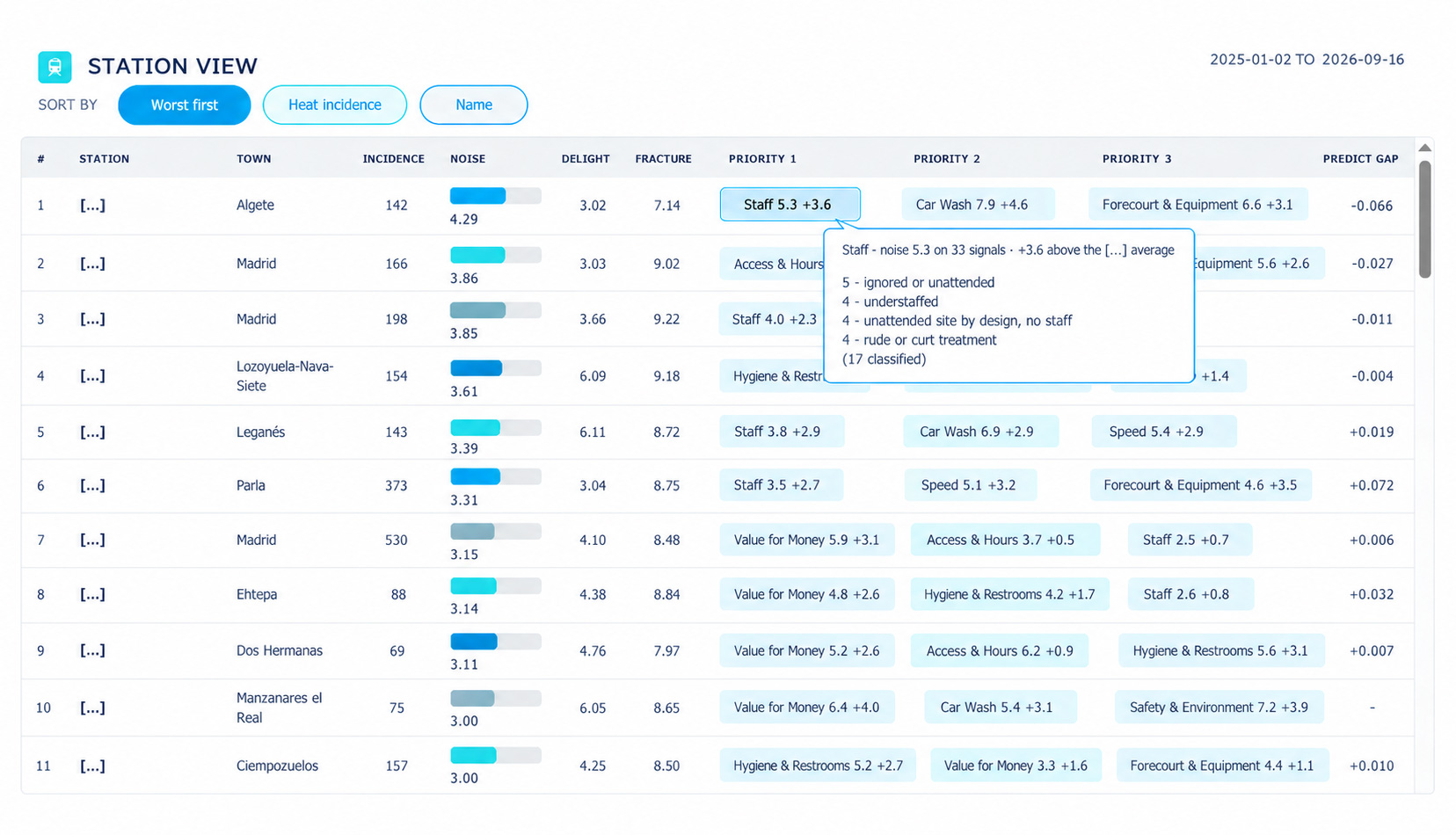
Site-level leaderboards help field managers identify the locations requiring attention and the specific issues to investigate. As an example: the station #1 in Algete needs to address how staff is addressing customers and needs to look into fixing issues with the car wash.
For field teams, the analysis can support a more focused approach to performance improvement. Managers can use customer feedback alongside existing operational measures to prioritize interventions at individual locations.
In practice, this means:
- Identify priority sites. Use noise scores and trends to flag locations where customer disappointment is unusually high or increasing.
- Diagnose the underlying issues. Analyze review themes to establish whether problems stem from local operational failures or wider commercial decisions.
- Assign corrective actions. Give site managers or field teams clear responsibility for addressing the issues within their control.
- Monitor the response. Track subsequent customer noise feedback alongside operational and commercial KPIs to assess whether conditions are improving.
For network leadership, N2M provides a clearer view of where customer experience is under pressure. For field managers, it offers specific guidance on where to focus their efforts.
The framework helps answer a question central to effective retail execution: what should we do next to create the greatest value?
For fuel retailers, protecting visit frequency requires consistent execution across the network. By making customer disappointment visible at site level, N2M helps management identify where standards are slipping and direct resources toward the improvements most likely to strengthen customer preference.
Discover how Simon-Kucher can help your fuel retail network identify sources of customer disappointment, prioritize site-level improvements, and strengthen commercial performance. Learn more about our broader capabilities in Energy & Utilities.