
Too many organizations treat deal governance as a reactive approval mechanism designed to prevent bad deals. Best-in-class deal governance goes further. It is a systematic commercial capability that helps organizations structure better deals, accelerate decision-making, and improve economic outcomes without introducing unnecessary friction into the sales process.
Unpacking deal governance
In many organizations, the Deal Desk serves primarily as a control function that conducts standard profitability assessment, reviews discounts, approves exceptions, and enforces commercial policies. By the time the deal reaches the desk, key commercial parameters have often already been negotiated. This leaves the organization to approve, reject, or make marginal adjustments to a largely predetermined outcome. Governance, in these instances, is often seen as a trade-off between price discipline and sales velocity; effective governance should improve both.
The opportunity goes beyond making Deal Desks more efficient. It requires expanding the role of deal governance into a broader organizational capability.
We define deal governance as a coordinated set of commercial policies, organizational responsibilities, decision-making processes, and enabling capabilities embedded throughout the customer lifecycle, including new business, expansion, and renewals. The Deal Desk is one possible organizational mechanism for executing governance, but not synonymous with governance itself. Equally, sales enablement remains a dedicated function but also plays a critical role in helping organizations achieve the objectives of improved deal economics and velocity.
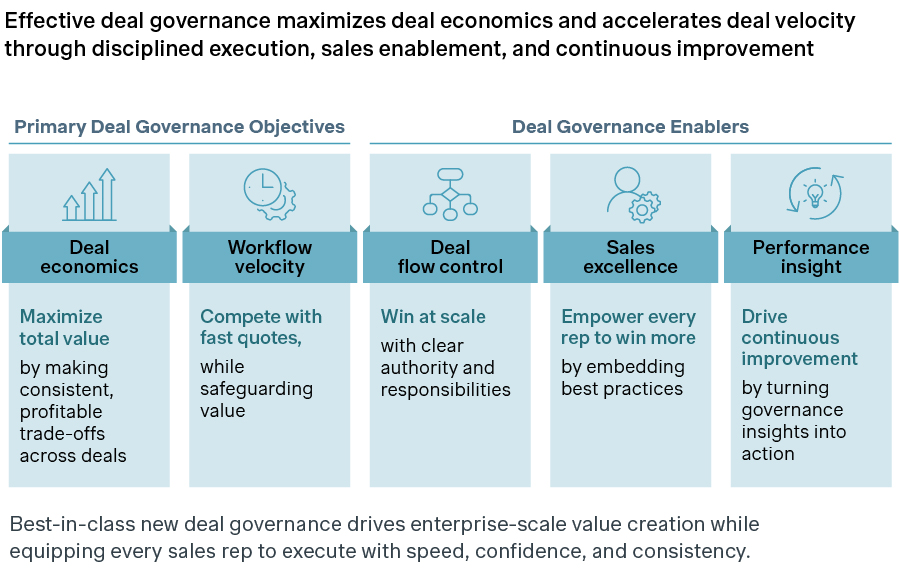
The central objectives of deal governance are two-fold: maximize total value by making consistent, profitable trade-offs across deals and compete with fast quotes while safeguarding value. We define these two objectives as deal economics and deal velocity, respectively. To achieve these central objectives, we focus on three core enablers: deal flow control, sales excellence, and performance insights.
Assessing internal capabilities
Through the lens of these three core enablers, we can focus on the strength and maturity of an organization's internal capabilities, including processes, governance interactions, people enablement, systems, and metrics. Importantly, no individual capability alone is sufficient on its own. Better analytics without defined decision rights cannot consistently influence deals. Faster workflows without economic intelligence simply accelerate existing decisions. Strong policies without actionable guidance risk turning governance into an obstacle for Sales. Sophisticated tooling without organizational adoption has limited value. Best-in-class governance is an integrated commercial operating system, not a collection of approval rules or an investment in technology.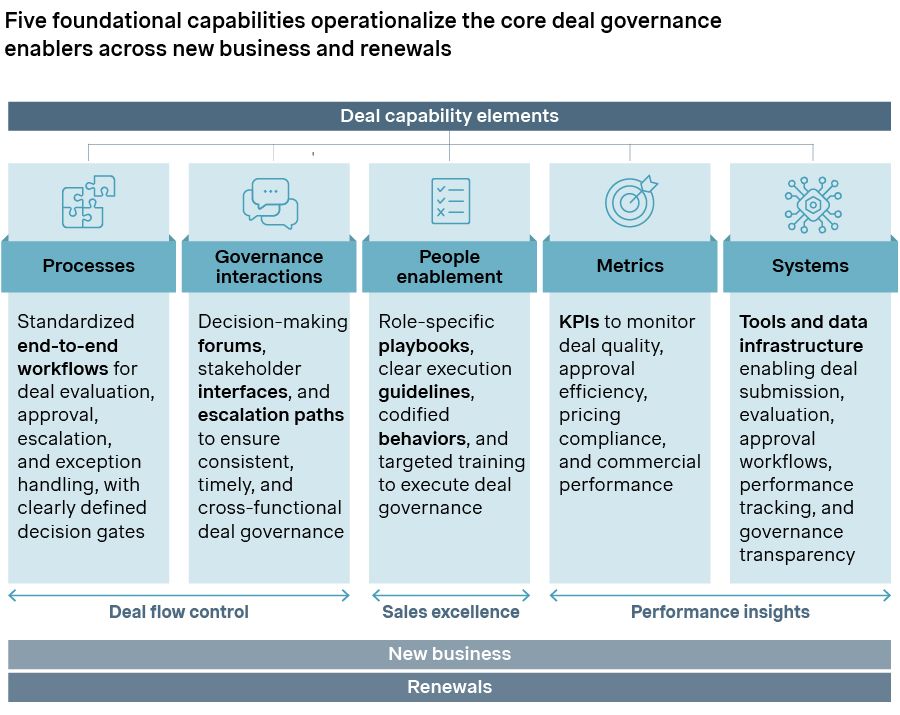
While these governance objectives, core enablers, and supporting capabilities are broadly consistent, the organizational model and specific level of intervention must reflect each company's commercial reality. Two key dimensions influence the model: deal complexity and deal volume.
Deal complexity is the degree of customization, risk, and coordination required to structure and approve a deal. It is driven by factors such as pricing exceptions, product bundling, and contract terms. Deal volume is the frequency and scale of deals requiring support within a given period. It is typically measured with respect to the percentage of overall bookings and peak loads at period end.
The level of governance should reflect the deal:
Routine, low-risk transactions should move through standardized or automated workflows with minimal friction.
Complex, high-value opportunities benefit from early strategic involvement and cross-functional problem solving.
Many organizations require a two-speed model that combines efficient, rules-based execution with more sophisticated strategic advisory support.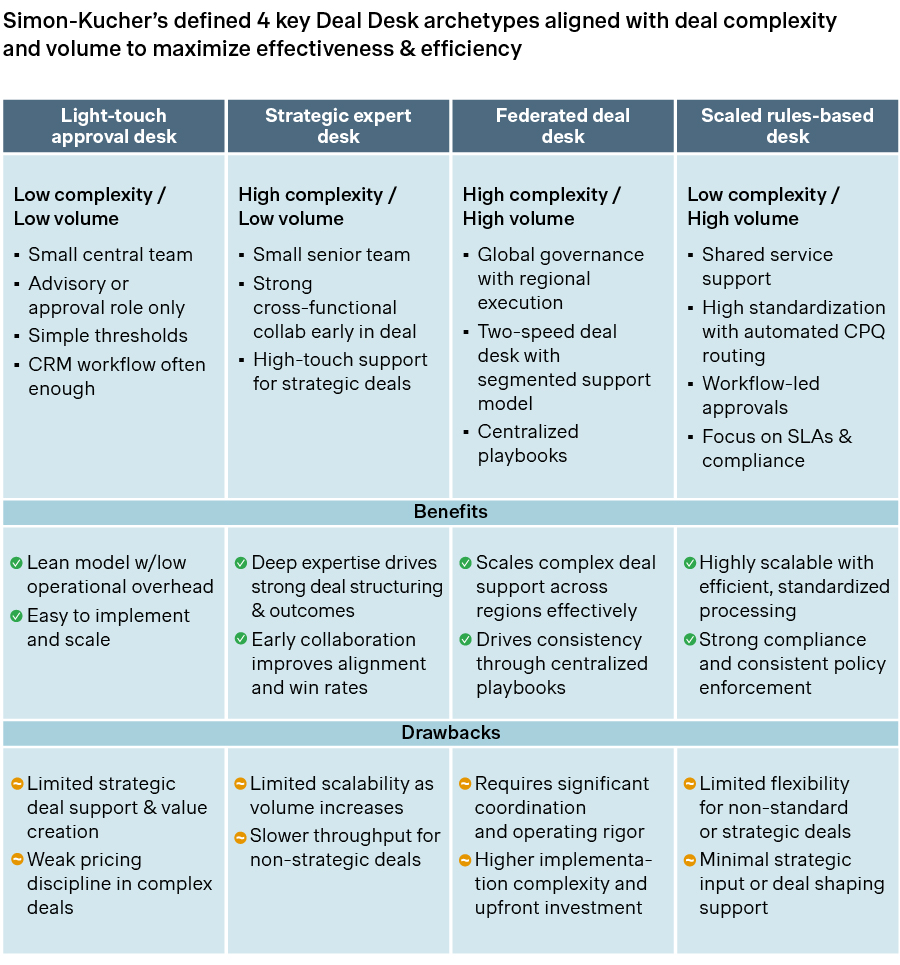
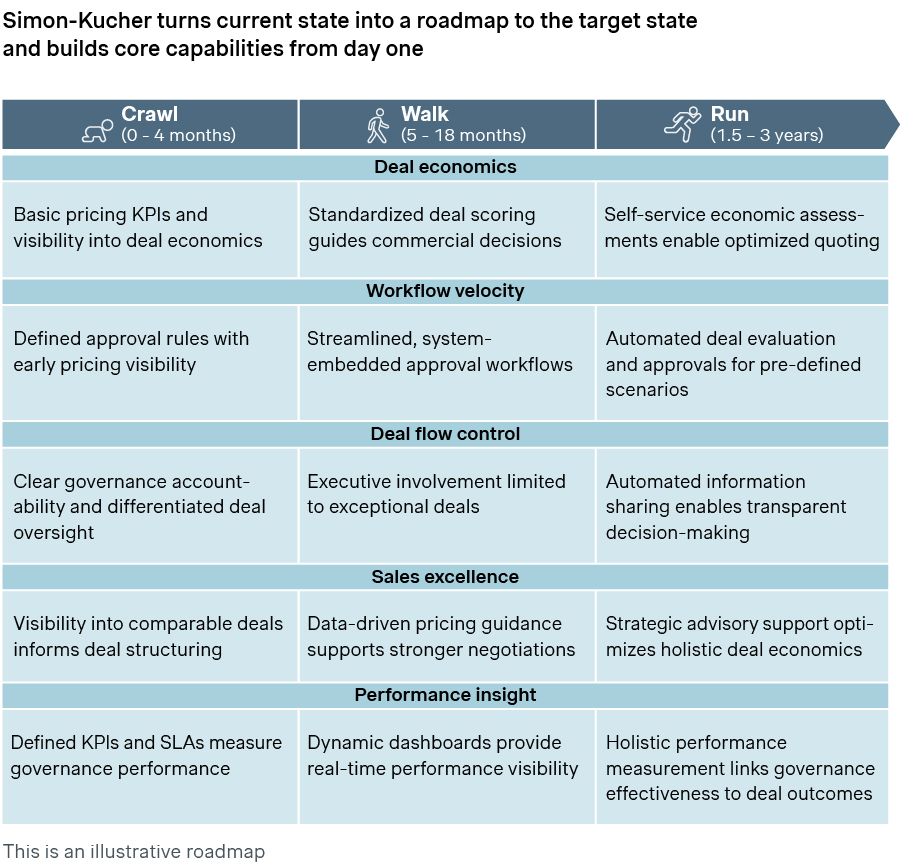
For most organizations, the question isn’t whether deal governance exists, but how mature it is across the core governance domains. Whether you’re establishing a new Deal Desk or moving from ad hoc to automated governance, consider a crawl-walk-run approach. Effective governance can exist at the crawl stage. As it matures, it moves from policing decisions to informing them, then to shaping decisions and driving materially improved outcomes.
Importantly, maturity is not synonymous with organizational complexity. A lean Deal Desk can be highly mature if its processes, guidance, and technology are appropriate for its deal environment; conversely, a large, centralized function can remain relatively immature if it primarily processes exceptions without improving commercial decisions. Organizations may also operate at different maturity levels across capabilities, requiring a targeted rather than uniform transformation roadmap.
Integrating deal governance for greater commercial impact
Effective deal governance helps your organization make better commercial decisions, faster, without adding unnecessary bureaucracy. The right governance model will differ by organization, but integrated capabilities remain essential to supporting deal flow control, sales excellence, and performance insights.
As you consider how to strengthen governance within your organization, ask yourself three questions:
Are you primarily reviewing commercial decisions, or proactively improving them?
Do you have the economic insight to assess the holistic quality of a deal, beyond its discount?
Are your governance processes calibrated to accelerate routine deals while dedicating appropriate expertise to strategic opportunities?
If you are ready to move beyond approvals and unlock greater value from every deal, connect with us to discuss how to elevate your deal governance capabilities.