Medtech and diagnostics companies are at very different stages of sales digitization. While many still need to strengthen core CRM, data, and commercial processes, AI is expanding what – and how – medtech and diagnostics sales teams can automate and augment. This article explores how commercial leaders can fix the basics, make better use of digital tools, deploy embedded AI and specialty AI solutions, and develop agentic sales capabilities where they can create measurable value.
The vision for AI-enabled sales is to shift more of a rep's time from administration to active selling. AI can analyze data, generate recommendations, prepare content, and automate simpler tasks, while AI agents can increasingly coordinate and execute activities across the sales journey. A 2026 survey of medtech sales reps found that AI users are hitting or surpassing their quota at three times the rate of those who don't.
Yet, many medtech and diagnostics companies still struggle to fully utilize the CRM and sales technology they already have in place. Only 19% of medtech organizations report universal CRM adoption among at least 75% of their field team.
Poor data quality, fragmented workflows, low CRM adoption, and unclear ownership can reduce the value of both existing sales technology and new AI capabilities. But companies do not need to complete a full digital transformation before exploring AI. Targeted AI use cases can help address specific gaps in systems and data while demonstrating value quickly.
For commercial leaders, this raises a broader technology question: where should existing CRM and sales tech capabilities be enhanced and where can AI improve sales performance? The answer will vary by use case and by the maturity of the organization.
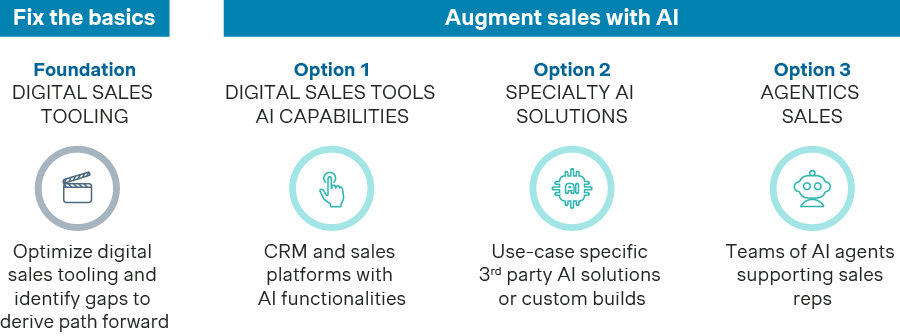
A pragmatic approach starts with the desired commercial outcome rather than the technology. Companies should define the sales decisions, workflows, and customer interactions they want to improve, assess the gaps in their current setup, and then decide whether to optimize existing digital tools, activate embedded AI capabilities, add specialty AI solutions, or redesign selected workflows leveraging AI agents.
Source: Simon-Kucher
Why your digital sales basics still matter in the age of AI
Digital sales performance rests on a foundation that aligns commercial priorities, workflows, data, sales tools, ownership, and adoption across an organization. When these work together, they improve sales execution in their own right and create stronger conditions for AI to add value.
In reality, many medtech and diagnostics companies already use CRM and supporting sales platforms, yet the commercial impact often falls short of expectations. The issue is rarely the absence of technology itself. More often, commercial requirements were not sufficiently reflected in the design, sales-user needs were only partially addressed, tools remain complex, data is fragmented, and ownership across functions is unclear.
Weaknesses in the digital sales foundation also restrict AI to isolated use cases rather than broader, connected commercial workflows. In other words, another layer of technology will not compensate for shortcomings in the underlying digital sales setup.
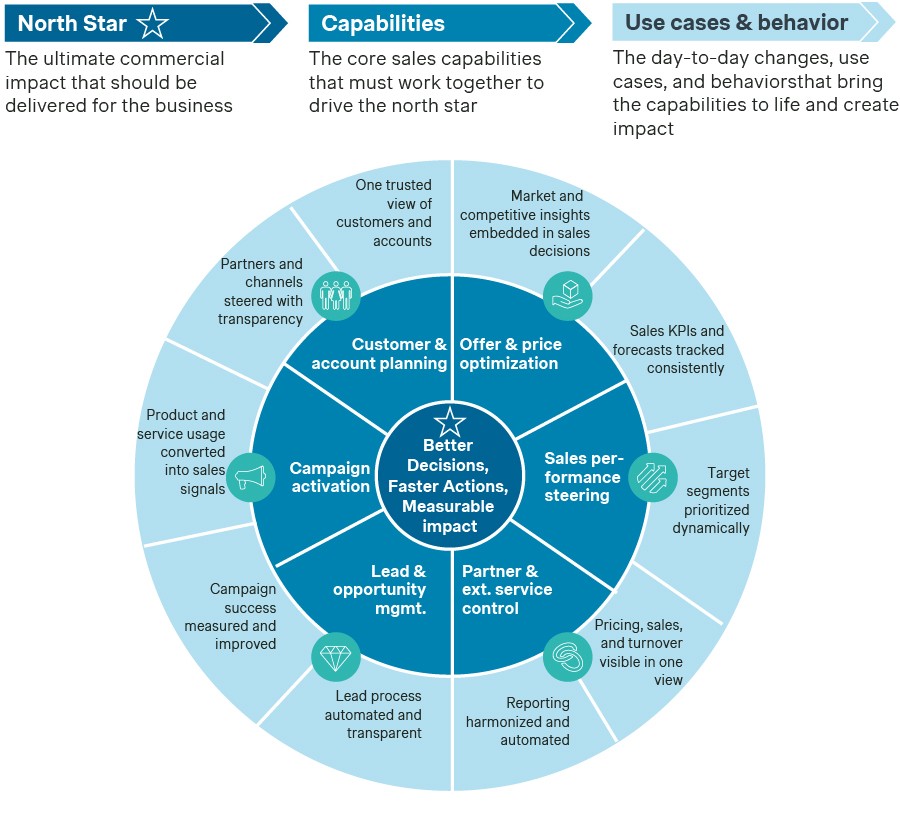
This is why a clear commercial North Star matters. It should first identify the commercial capabilities needed to deliver the desired outcomes and KPIs. These may include account prioritization, opportunity management, customer engagement, next-best-action, or sales planning. These priorities then inform the target operating model – including the required processes, roles, and ways of working – and the data, technology, and analytics needed to support it. Change management should be embedded from the outset to ensure that new capabilities are adopted in day-to-day sales activities.
Source: Simon-Kucher
This sequence is critical to building a future-proof commercial model. Starting with technology instead of commercial need often leads to poor workflow fit, which in turn weakens adoption and impact.
A capability-led approach reverses that order: define the outcomes and use cases first, identify the gaps in process, data, and technology, and then determine whether the gap calls for better use of existing tools, embedded AI, a specialty solution, or an agentic workflow.
Where can embedded AI create value in existing sales platforms?
For many companies, AI capabilities built into CRM and sales platforms offer a straightforward way to add automation and decision support without introducing another tool.
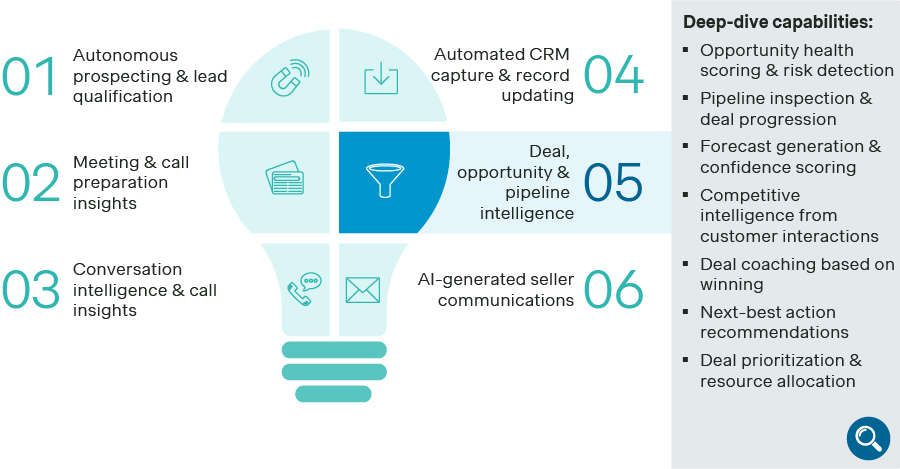
Embedded AI is focused around high-friction sales tasks, supporting better prospecting and lead qualification, conversation intelligence, pipeline analysis, etc. At the more advanced end, it can assess opportunities from health scoring and provide competitive intelligence.
Source: Simon-Kucher
Many of these features carry additional recurring or usage-based fees, making actual utilization an important part of the business case.
However, embedded AI also has limits. Most platforms are designed around generic sales activities rather than company- or industry-specific workflows; recommendations are constrained by the data and logic available within the platform; and future capabilities depend partly on the vendor's roadmap.
It's this distinction that helps separate workflows that can be improved within the existing platform from those that may be better served by specialized or agentic approaches.
Where can specialty AI address more specific medtech sales needs?
Core CRM platforms are not designed for every commercial workflow. A growing range of specialty AI tools is being built around specific sales and marketing needs, including:
Demand and outreach: automate prospecting, account research, personalization, outreach, and meeting generation
RFP and tender management: identify opportunities and help draft, review, and submit RFPs, tenders, questionnaires, and proposals
Enablement and coaching: support roleplay, call coaching, seller readiness, and communication tools
Conversation and workflow: record and analyze conversations, generate CRM updates and follow-ups, and surface coaching signals
Account intelligence and orchestration: combine account, intent, signal, and market intelligence to help sales team prioritize where to act
Content and personalization: create, adapt, personalize, govern, and optimize marketing and sales content at scale.
A conversation and workflow tool in the market today shows how focused these solutions can be. During a call with a clinician, sales reps can use it to analyze the discussion and surface relevant prompts; afterwards, it can generate follow-up actions and update CRM and coaching records. Reported benefits include faster coaching cycles and more consistent field execution.
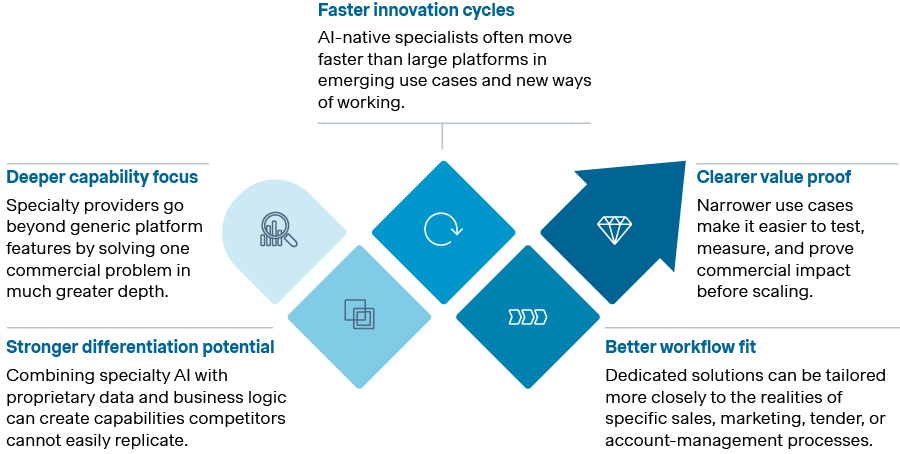
The narrower focus allows specialty tools to fit a workflow more closely than generic platform features, incorporating proprietary data and business logic, and make the impact of a focused use case easier to test. Specialist providers may also develop capabilities in emerging areas faster than larger platforms.
Source: Simon-Kucher
But many solutions in this market are still relatively new, making careful evaluation important before another tool is added to the tech stack.
Five key watch-outs in AI vendor selection and broader rollout:
Start with the sales workflow rather than the feature demo
Check the quality of the underlying data before assessing output
Assess integration with the existing commercial architecture
Define accountability between AI and human decision-makers
Use pilots to test value, adoption, and readiness.
What does agentic sales look like in practice?
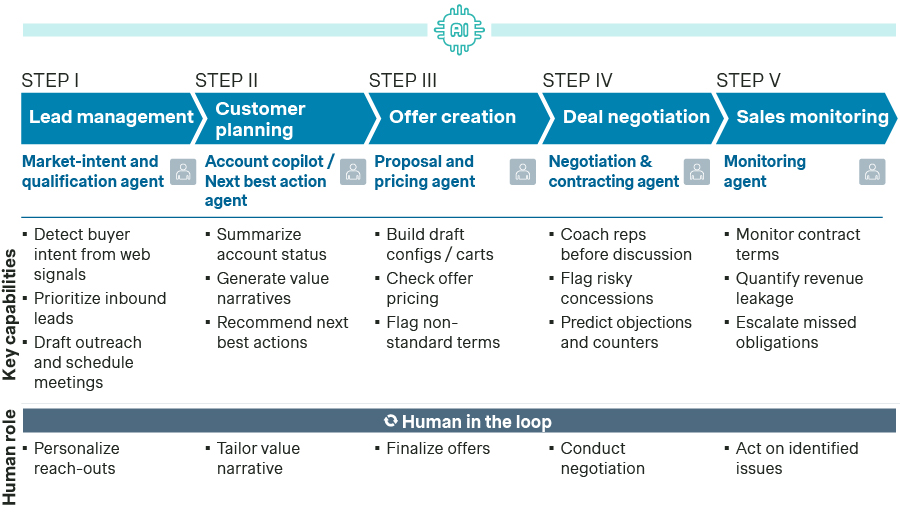
AI agents can connect with multiple systems, data sources, and communication channels to execute and coordinate tasks with greater autonomy across different stages of the sales process.
Falling AI costs are making agentic sales more viable, but total running costs can still rise quickly. Agents can execute multi-step workflows and continue operating without constant human input, using 10-20 times more computing resources than simpler AI applications. Now the important question is whether that added autonomy creates enough value to justify the higher running cost.
Interestingly, top sales leaders are already recognizing that not every workflow needs an AI agent. Across the sales journey, agents can support activities from lead qualification and account planning to offer creation and contract monitoring, while human sellers retain judgement at key customer and commercial decisions.
Source: Simon-Kucher
The more useful question is where greater autonomy can improve performance without introducing unnecessary complexity or risk. A structured assessment can help identify those opportunities:
Map the current process. Break the workflow into its individual tasks, handoffs, decision points, data sources, and systems to understand how the work is performed today.
Assess agent suitability. Determine which parts of the workflow are appropriate for agent support, taking into account the complexity of the task and the risks associated with greater autonomy.
Define the agent’s role. Specify what the agent will do, the information and tools it can access, the outputs it is expected to produce, and where guardrails or human review are required. Success measures should also be clear from the outset.
Prioritize the strongest use cases. Compare suitable opportunities based on their potential business value and time to value rather than trying to automate every possible task.
Test before expanding. Prototype the agent within a bounded workflow, validate its impact and reliability, and expand its use only once the approach has proved effective.
Case study
How strong digital foundations delivered $10 million in revenue uplift from an agentic sales program
A global medtech company introduced AI agents across its sales process, supporting areas such as account analytics, sales storytelling, meeting preparation, and negotiation.
The company reported a 2% price uplift in key accounts, improved win rates for deals supported by a negotiation coach, and $10 million in revenue uplift through stronger contract compliance.
It already had a strong enterprise data and technology foundation. The results were supported by simpler processes, clear governance, stronger data science capabilities, better sales team adoption, and executive sponsorship. These conditions helped the company scale the agentic model and capture more value from it
How should commercial leaders move forward?
The choice between existing digital tools, embedded AI, specialty solutions, and agentic workflows is only part of the decision. Commercial leaders also need to consider whether the sales model, technology environment, and organization can support the chosen approach.
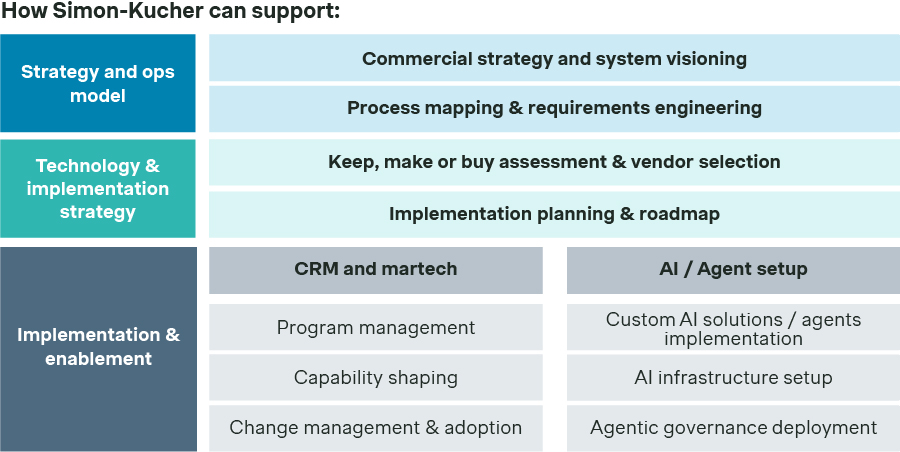
The right path forward depends on three dimensions:
Strategy and operating model: Are the commercial ambitions clear, and have current processes, readiness, roles, governance, and capability gaps been assessed thoroughly to define the target operating model?
Technology and implementation strategy: Which needs can be addressed with existing tools, where are upgrades required, and where should new solutions be built, bought, or introduced?
Implementation and enablement: How will the chosen CRM, MarTech, AI, and agent solutions be implemented, governed, adopted, and scaled – and how will value be tracked?
Organizations that take this end-to-end approach are better positioned to drive adoption, avoid unnecessary technology complexity, and convert digital and AI investments into measurable improvements in sales productivity and commercial impact.
Source: Simon-Kucher
Interested in a deeper look at where AI can support commercial teams and how to assess the right use cases? Watch our webinar recording.