Treating culture as a commercial lever
Sales organizations often struggle to achieve consistent profitable growth due to persistent commercial challenges that limit performance and scalability.
As sales culture becomes a more obvious driver of business results, CROs, and now even CEOs and CFOs, are considering more enterprise value creation levers to address this organizational foundation.
In this sales excellence series, we will examine six different contributing factors and opportunities to improve sales culture:
I. The sales culture ecosystem (covered in this article)
II. Leadership’s role
III. Playbooks, tools, and selling routines
IV. Talent and hiring models
V. AI’s disruption
VI. The value of outside evaluation
These factors help explain how sales culture is shaped, where it breaks down, and how CROs can build stronger execution under pressure.
Why CROs are prioritizing sales culture
New CROs may feel pressure to create momentum quickly. That instinct is understandable since sales organizations need a clear mission, organizational buy-in, and a repeatable operating cadence to move. But momentum is fragile when the mission becomes disconnected from the operating model. It may energize the room at kickoff, but it rarely survives the first hard forecast call if the system still teaches yesterday’s lessons.
One of the first challenges for any CRO is accurately evaluating their organization’s culture. Employees often display behaviors they know leaders expect to see. Forecast reviews sound disciplined, and sales teams sound aligned, but this may not reflect how the organization actually operates.
A sales organization’s mission and core values are tested constantly by real-world obstacles and set-backs. The real question is not whether the values sound right, but whether the operating model preserves the organization’s commitments under constant competitive pressure.
For example:
- A seller knows a deal is slipping and must decide whether to surface the risk early to get help, but may have to share credit and commission as a result
- A company’s highest producer might ignore a set process and weaken standards by avoiding CRM updates to use more time to pad quota attainment
- A large expansion opportunity looks attractive commercially but carries significant adoption risk that could be thrown over the wall to Customer Success and/or Operations
- A Vice President knows that a top performer might quit unless they receive a disproportionate share of qualified leads that would otherwise help ramp up new hires
These moments of truth reveal gaps between an organization’s values and challenging daily decisions that can be addressed by building a sales culture that is designed, cultivated, and sustained through strong leadership, planning, and management.
The forces behind sales culture
A sales culture consists of multiple forces working together. This system is not meant to reduce culture to a chart, nor does it suggest that each component can be changed in isolation. Rather, it indicates how many parts of the commercial engine are constantly teaching the field what matters, and the number of variables considered when a CRO architects a culture to match the company’s goals, values, and talent.
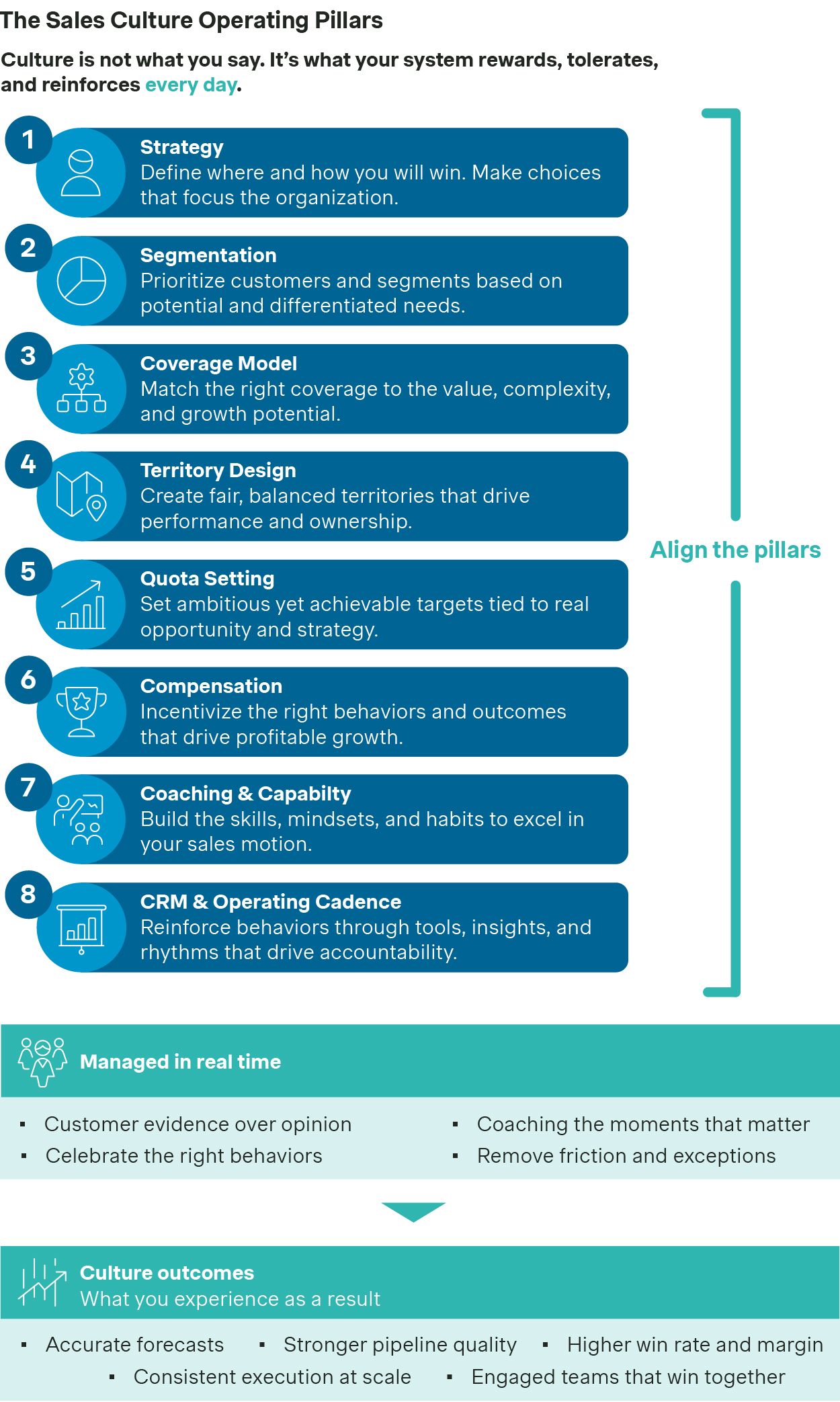
- Sales strategy tells the field where growth should come from
A clear strategy informs sellers which customers, offers, and opportunities matter most and how to win in the face of competition. When everything is a priority, sellers gravitate toward the easiest to win. As markets, customers, and competitors evolve, CROs need to keep rethinking sales strategy. - Segmentation determines where resources go
Segmentation directs attention toward customers that deserve the most focus. Over time those choices shape the capabilities sellers need, the coaching managers provide, and the conversations that define the culture. A company pursuing complex enterprise accounts will build a very different sales culture than one chasing high-velocity transactional growth (patience vs pace, etc.). If segmentation is based on legacy relationships or internal convenience rather than customer fit, urgency, and potential, the culture will follow the wrong customer signal, or worse, ignore signals entirely. - Coverage choices indicate what the company truly values
Coverage determines who gets attention, how much, and from whom. It also shapes how people work together to serve the customer. A coverage model can create a solo culture, where sellers carry the burden alone, or a team-based culture, where account executives, specialists, customer success, and leadership coordinate around the opportunity. Getting coverage right is integral to organizing sales to be fit for growth. Coverage also starts to identify where different resources will need to work together due to overlaps or adjacencies. - Territory design shapes trust
Territories built around market opportunity, customer potential, and the support model required to win create focus and belief. When they are built around legacy ownership or internal politics, sellers see the system as something to protect or game. Well-defined territories create clarity and accountability which are two strong contributors to sales culture. - Quota setting shapes belief
Quotas grounded in market opportunity, account potential, and achievable growth can stretch a team without breaking trust. However, quotas built from top-down math often do the opposite. Sellers stop believing the number, engagement declines, and managers are forced to work around it. - Incentives and compensation convert priorities into behavior
Sellers are often disparaged as being “coin-operated” in the workplace. But what critics miss is that sellers can be one of the clearest canaries in the coal mine for a company’s GTM strategy. They tend to act according to what is in their own interest, and in a healthy culture, what is in it for them should also be accretive to the organization. - Manager coaching rhythms turn expectations into habits
The front-line manager is where most sales culture becomes real. Deal reviews, forecast calls, pipeline inspections, pricing discussions, ride-alongs, and account planning sessions all carry cultural weight. The questions managers ask will become the questions sellers prepare for. In tougher markets, those managers also need to coach for value, discipline, and commercial judgment, not just activity. - Sales process and CRM shape what gets inspected
A useful sales process helps sellers advance deals, identify risk, and guide the customer toward a decision. CRM can reinforce customer evidence, next steps, deal quality, and forecast discipline. Or it can become a reporting tax that managers and reps quietly work around. That distinction matters because CRM fatigue and poor pipeline hygiene are often symptoms of a system sellers do not believe adds value to their daily lives. Yes, we know the CFO needs an updated forecast, but what does the rep get out of that effort? Leads? Insight? Only if that is the system you set up.
Talent strategy, selling routines, and leadership behavior cut across every part of the ecosystem. They determine who joins, who advances, what sellers are equipped to do, and which standards hold when pressure rises.
How do these forces interact?
In many cases, sales organizations try to surgically adjust individual parts of the system, leaving the rest untouched. This siloed approach creates glaring contradictions that can weaken sales culture without solving the root issue.
Wells Fargo offers a cautionary example of what happens when the pressure affecting the C-Suite is not translated into a coherent commercial system. The bank’s public value was customer trust, but the operating signal was product volume. As a result, unrealistic sales goals created incentives that led employees to open millions of unauthorized accounts and enroll customers in products under false pretenses or without their consent.
Ultimately, Wells Fargo’s growth ambition lacked clarity and a clear operating standard which created a scorecard that overpowered the bank’s stated values and mission.
Situations like this are when the CEO and CRO both matter. The CEO needs to align the company’s growth objectives, while the CRO translates that mandate into a sales system the field can execute responsibly. If headcount is flat, the answer cannot simply be “sell more.” The organization must decide which customers deserve more focus, which offers to create durable value, how coverage should be deployed, what quotas are credible, how incentives should work, and what managers must inspect before pressure turns into misconduct.
That clarity matters because confusion is expensive.
To quote the late Steve Jobs, “People think focus means saying yes to the thing you've got to focus on. But that's not what it means at all. It means saying no to the hundred other good ideas that there are.”
Diagnosing the ecosystem
The best CROs understand that heroism is not a strategy that is scalable. Hero sellers have a place, and every organization needs individuals who create energy and prove what is possible. However, an organization cannot design around or forecast exceptions. A few stars can save a quarter, but a better system can change the year.
Culture becomes sustainable when performance is no longer dependent on a small group of people overcoming the system, but when the system helps average people achieve success. A CRO who wants to understand the culture should start where the system reveals itself. Once a CRO sees those moments clearly, culture stops being abstract and becomes a set of commercial choices.
Our next article in this series will explore leadership’s role in managing excellent sales culture in more depth.
How Simon-Kucher can help
We help CROs redesign the commercial system so the behaviors leadership expects are mirrored in the behaviors sellers experience, practice, and get paid to repeat.
Form placeholder. This will only show within the editor