
Banks have long had an advantage in financial breadth. But customers now have credible alternatives for an increasing range of financial needs, making it easier to spread their financial activity across multiple providers.
Take the Relationship Strength Assessment – Assess your bank's positioning.
Neobanks and specialist providers have raised the competitive bar across everyday banking, merchant acquiring, lending, cross-border payments, and investing. Their advantage is rarely access to a product an incumbent cannot offer. More often, it is a stronger proposition around a specific need: focused technology, intuitive journeys, fast onboarding, transparent pricing, or differentiated features and service.
Simon-Kucher's Global Neobanking Study 2026 shows how far this shift has progressed. Neobanks now capture 39% of new banking relationships globally and hold 19% of banking accounts. More importantly for incumbents, the neo-banking relationships are deepening while customer satisfaction is 25% higher.
The competitive threat is not sudden displacement. It is the steady erosion of the relationship, one need at a time.
The pressure for banks today is increasingly about proposition quality as well as price. Primary-neobank customers report higher satisfaction than customers of large and national banks, with digital-first providers performing particularly strongly on fees, onboarding, digital experience, and innovation.
Incumbents still lead on important strengths such as trust, security, and service breadth. That gives banks a credible route to respond. They must combine those strengths with propositions that are competitive for the financial needs customers care about most.
Instead of asking which competitor to copy or which product to build next, banks should ask: where are customers using alternatives; what is driving those choices; and how can the bank use its broader relationship to strengthen its position?
Competition is fragmenting the banking relationship
The shift is not simply a substitution story where customers leave one institution and move everything to another. Multi-banking makes it possible for neobanks and specialists to win individual financial needs while the incumbent retains the core account.
A small-business customer may hold its operating account with one bank, use a specialist for acquiring, another for cross-border payments, and a digital lender for working capital. A retail customer can similarly spread everyday banking, savings, borrowing, investing, and other needs across several providers. The bank may retain the customer while progressively losing activity, data, engagement, and economics around the relationship.
Product breadth is only an advantage when customers experience it as one connected proposition.
Our Relationship Strength Map is built around two dimensions: proposition competitiveness and relationship integration. It asks two fundamental questions:
1. For the financial needs that matter most to our target customers, are our propositions competitive with the best alternatives?
2. Do our products and propositions work together to create a holistic financial relationship?
The Relationship Strength Map
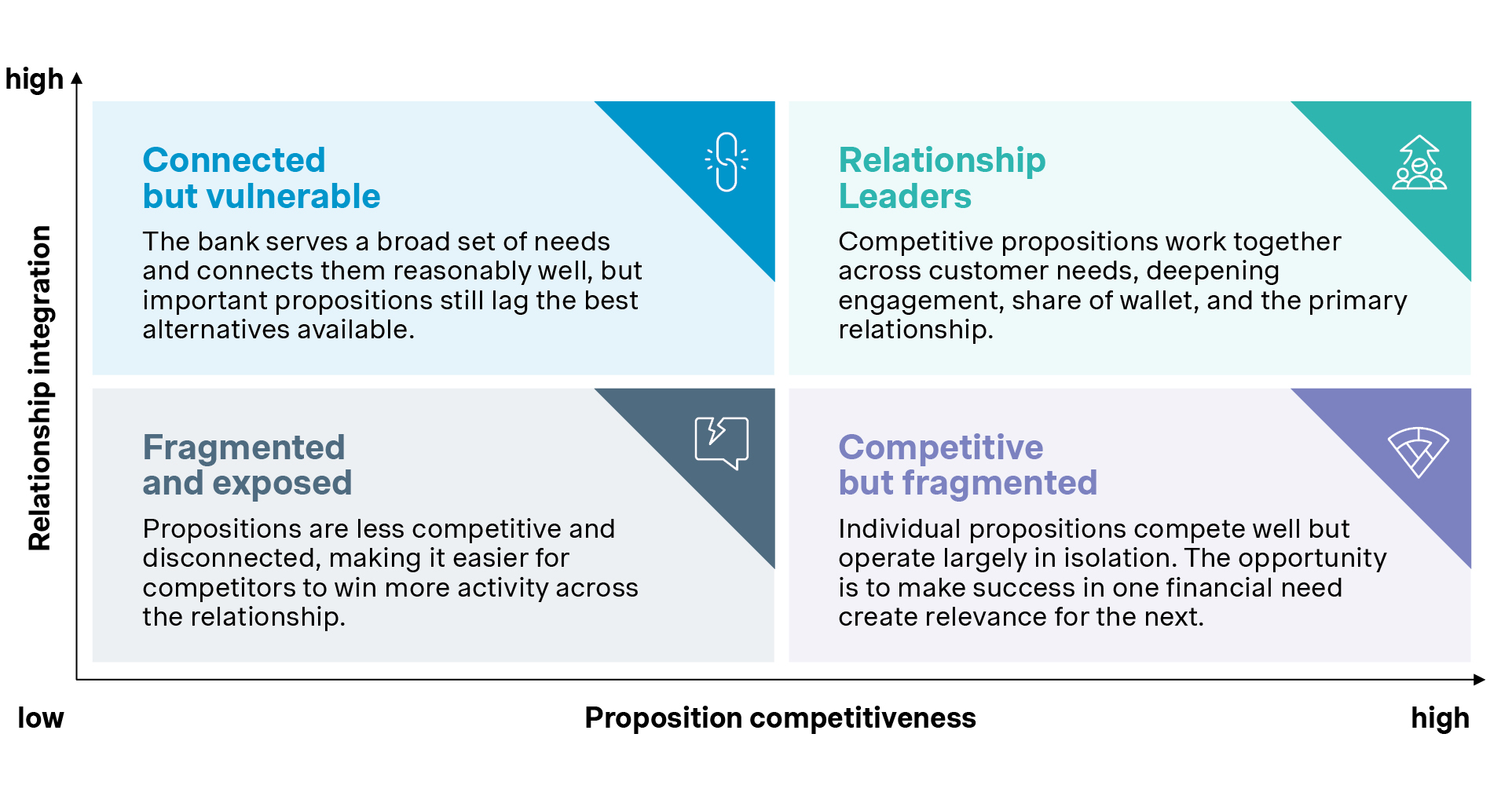
A bank can offer a broad, connected relationship while still losing important parts of that relationship because a neobank or specialist has a stronger proposition for a specific financial need. Equally, it can have competitive individual propositions that operate largely in isolation. Moving to the right means making the propositions for priority financial needs competitive; moving upward means making those propositions reinforce one another.
The objective is not to lead in every financial need. Trying to offer the best proposition in every category may require disproportionate investment, aggressive pricing, or economics that are difficult to sustain. Banks need to be explicit about where superior performance materially strengthens the customer relationship, where matching the market is sufficient, and where their advantage comes from connecting several needs better than individual specialists can.
That means concentrating investment and commercial firepower on propositions that matter most to target customers and to the economics of the broader relationship.
Moving toward the top-right requires banks to address five priorities: identify where competitors are gaining ground; close the proposition gaps that matter most; connect products into a holistic relationship; monetize that relationship; and turn its potential into sustained customer behavior.
Five priorities to turn breadth into relationship advantage
1. Identify the financial needs where competitors are gaining ground
Banks are traditionally organized around products. Customers are not.
A business owner wants to get paid, manage cash, pay suppliers and employees, fund growth, and operate efficiently. A retail customer wants to manage everyday finances, save, borrow, invest, and protect what matters. Competitors do not need to replace the whole bank to create pressure. They only need to offer a more compelling proposition for one important need.
The first task is to investigate the leakage. Which financial needs are customers increasingly using neobanks or specialists for? What is driving those choices? And what does that cost in activity, share of wallet, primary-bank status, retention, or economics?
Retail FX illustrates how specialists can take ownership of a financial need that once sat naturally with the primary bank. Revolut and Wise reset expectations through competitive FX, multi-currency accounts, cards, and intuitive digital journeys. HSBC responded with Global Money, which reached more than 1.3 million customers by the end of 2023. Following its success, HSBC launched Zing as a standalone proposition but closed it down about a year later. The lesson is not that incumbents cannot compete, but that replicating specialist features is not enough: banks need to choose where they can build a compelling proposition and use it to strengthen the broader relationship.
Leading institutions turn that fact base into a ranked agenda. They focus on the few financial needs where closing the gap can materially strengthen the wider relationship, rather than reacting to every competitor move.
The most important gaps are not always missing products. They are the financial needs customers are increasingly meeting elsewhere.
2. Close the proposition gaps that matter most
Once the priority gaps are clear, the next question is how to close them quickly. Not every problem requires a new product or a major technology rebuild.
A proposition gap may exist in the product itself, or in onboarding, pricing, service, or the end-to-end customer journey. Some gaps can be closed by improving what already exists. Others require capabilities that the bank does not have. The response can be to improve, build, buy, or source specialist capability; the choice should follow the target customer outcome, speed, and economics.
The delivery choice should follow the customer problem, not lead it. Where a specialist can close the gap materially faster, using external capability can be the pragmatic answer. But the bank should decide upfront what must remain under its control - for example the customer interface, data, pricing power, decision rights, and economics.
The question is not whether the bank can build every capability. It is how quickly it can close the proposition gaps that matter most.
Banks and digital-first providers are already importing specialist capabilities selectively to close priority proposition gaps. Lloyds launched Lloyds Accept in June 2026, integrating Stripe Connect into its Business Account to give small businesses Tap to Pay, payment links, and modern terminals. Morgan Stanley selected Wise Platform to enhance cross-border settlement for corporate clients. Tide partnered with Adyen to enable Tap to Pay for small businesses, while Nubank integrated Wise Platform to offer multi-currency accounts and international debit cards in its own app. This is not partnership for its own sake. Banks are using the fastest credible route to strengthen the proposition for a financial need that matters.
The point is not to maximize external partnerships. It is to combine speed with selectivity: use the fastest credible route to the required proposition while protecting the elements that matter to long-term advantage.
3. Turn product breadth into one connected proposition
Competitive propositions for individual financial needs are necessary, but they do not create relationship advantages on their own. A bank can compete strongly for several needs and still make customers assemble the relationship themselves.
The differentiating opportunity is to make range of products and propositions work together around the customer's broader financial needs, rather than leaving the customer to navigate the bank's product silos. Discovery, eligibility, onboarding, identity and data reuse, packaging, pricing, service, and navigation between products should work together. For business customers, payments, deposits, lending, FX, and cash management should reinforce one another. For retail customers, the same principle applies across everyday banking, savings, borrowing, investing, and insurance.
Coherence does not require every capability to sit on the same technology stack or come from the same provider. It requires the customer to experience one bank, and the bank to use what it learns across products to make the next interaction more relevant.
Customers should not have to assemble their own bank from a collection of providers.
In one Simon-Kucher engagement with a regional bank, we helped connect everyday banking and investing into a more integrated retail-client proposition. Rather than treating current accounts and securities as separate product lines, we developed a modular architecture that linked the two, with propositions and benefits tailored to different customer groups. The result was a clearer path from daily banking into investing and a more coherent overall relationship.
This is where incumbents can turn breadth from a legacy of product silos into an advantage. A specialist may win one financial need; the bank can win by making multiple needs work better together within one relationship.
4. Monetize the relationship, not the product
Once those propositions are connected, economics becomes the test. Product P&Ls remain necessary, but they should not be the only unit of optimization.
Merchant acquiring illustrates the point. Its value can extend beyond acquiring margin to operating deposits, transaction activity, lending relevance, customer insight, FX, retention, and primary-bank status. The same logic applies elsewhere: a stronger cross-border, lending, savings, or wealth proposition may be worth more because of the relationship it protects or deepens.
The question is therefore not whether every product wins on its own; it is whether the combined relationship creates more value for the customer and the bank.
The right unit of optimization is the customer relationship, not the individual product.
In another Simon-Kucher engagement, we linked merchant acquiring more deliberately to the wider banking relationship. Most customers needed both services but used third-party acquirers - we designed acquiring promotions tied to deposit activity. Rather than simply discounting acquiring with hopes of winning volume, the approach grew deposits, deepened the relationship, preserved acquiring unit economics, and created a projected multimillion-dollar profit impact.
This changes how pricing and incentives should be designed. A product should not automatically be priced to maximize its standalone P&L if its use materially increases value elsewhere in the relationship. The bank needs to understand the incremental deposits, transaction activity, lending opportunities, retention, or share of wallet associated with different customer behaviours before deciding where to charge, where to reward, and where to invest.
That requires a relationship-level view alongside product economics: total contribution, balances, activity, share of wallet, retention, primary-bank status, and customer lifetime value.
Leading banks therefore add a relationship-level view to product economics: total contribution, balances, share of wallet, retention, primary-bank status, and customer lifetime value. That enables robust decisions on where to charge, where to reward, and where to invest.
5. Turn relationship potential into customer behavior
A strong proposition and holistic relationship approach create a foundation for growth. Commercial execution determines whether customers move more of their financial activity.
Leading institutions manage the relationship funnel deliberately. They know which customers are eligible for the next product, which signals indicate a relevant need, where activity is going elsewhere, and which interventions actually change behavior.
Digital journeys, relationship managers, service teams, campaigns, incentives, and next-best-action capabilities need to reinforce one another. A small-business customer receiving payments through the bank should encounter relevant cash-management, FX, deposit, or financing propositions when those needs emerge, not through disconnected product campaigns.
The objective is to move from product-by-product selling to systematically managing the next best financial need.
In a different Simon-Kucher engagement, we used relationship data to identify gaps in customers’ financial needs. A financial-health framework translated those gaps into achievable next steps, supported by an advisor tool and sales cockpit. With the target customers, 80% accepted an advisory discussion on the next relevant product. The value came from turning customer data into a clear trigger, relevant prompt, and actionable intervention rather than another generic cross-sell campaign
Leading banks operationalize this through a systematic trigger-to-action framework. Customer behaviour, transaction data, balances, product usage, life events, and other signals can indicate an emerging financial need. The bank then needs to translate those signals into a relevant prompt or next-best action, route it through the right digital or human channel, and learn from whether the customer responds.
The strongest systems therefore connect five elements: signal, trigger, prompt, action, and feedback. The objective is not to generate more leads or product campaigns. It is to identify the right financial need at the right time and make it easy for the customer to act.
Measurement still matters, but as a feedback loop rather than a starting point. Banks should understand which triggers lead to activation, repeated usage, greater share of wallet, or deeper relationship value, and must continuously refine the interventions accordingly.
Banks can still win the financial relationship
Neobanks and specialists have reset the benchmark by solving individual financial needs exceptionally well. Banks should take that challenge seriously, but they do not need to become the best specialist in every category.
Their advantage will be different: trusted relationships, breadth, balance-sheet capabilities, data, and distribution, combined with selective external innovation where it accelerates the customer outcome.
The winners will not be the banks with the most products. They will be the institutions that turn financial breadth into a relationship customers choose to consolidate around.
Where does your organization sit on the Relationship Strength Map?
We developed the Relationship Strength Assessment to turn the framework in this article into a practical executive diagnostic.
In around 10 minutes, it helps leadership teams assess:
- how competitive their propositions are for the financial needs that matter most;
- how effectively those propositions work together to strengthen the overall relationship; and
- which of the five priorities offer the greatest opportunity to improve their position.
You will receive:
- Your position on the Relationship Strength Map
- Your Proposition Competitiveness and Relationship Integration scores
- An assessment across the five priorities discussed in this article
- Your strongest areas and the most important gaps to address
- Practical priorities for strengthening customer and relationship value