
The durable goods industry is undergoing a transformation, driven by shifting macroeconomic dynamics, evolving global trade patterns, and changing consumer behavior. While these developments are reshaping competitive dynamics across the sector, they are also creating new opportunities for manufacturers to strengthen their positioning, build resilience and unlock growth.
Key developments include the impact of tariffs and geopolitical instability on the shift towards more regionalized supply chains, as well as changing consumer spending patterns driven by inflation and growing polarization between value-oriented and premium segments. In this article, we explore these developments and the strategic responses manufacturers can adopt to benefit from them.
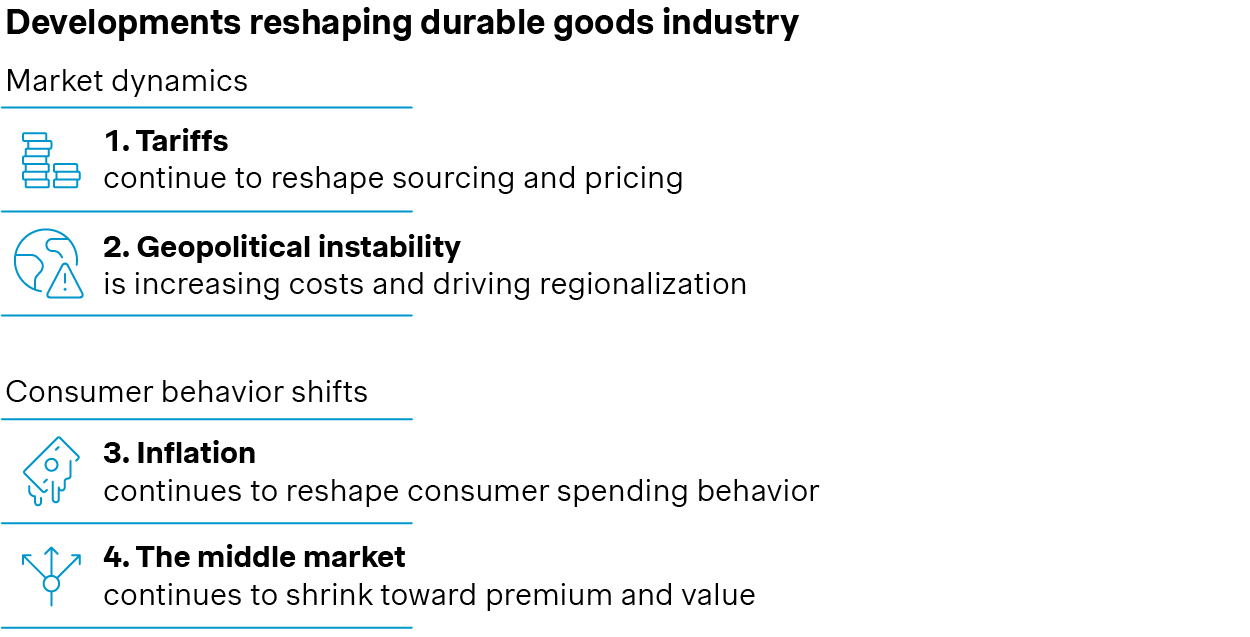
MARKET DYNAMICS
Tariffs continue to reshape sourcing and pricing
Tariffs have become a structural force within the durable-goods landscape. Ongoing US–China tensions, EU anti-dumping measures, and broader geopolitical fragmentation are reshaping sourcing strategies, raising import costs, and injecting volatility into pricing and financial planning. In response, many manufacturers are accelerating the broader trend toward deglobalization. Production is shifted closer to end markets through nearshoring and regionalization strategies, reshaping global sourcing networks to reduce exposure to tariffs and logistics disruptions. Production is increasingly moving toward regional manufacturing hubs such as Mexico, Eastern Europe, Turkey, Vietnam, and India. While these regionalized supply chains can improve resilience and shorten lead times, they often come with higher labor, operational, and investment costs compared to traditional low-cost offshore production models.
At the same time, tariffs are also reshaping global trade flows. As access to the US market becomes more challenging for Chinese manufacturers, a growing share of Chinese exports is being redirected toward other regions, including Europe. This is increasing competitive pressure across a range of durable goods categories, particularly in price-sensitive segments where European manufacturers are already facing higher cost structures. Together, these developments are reshaping competitive dynamics across the durable goods industry, creating a greater need for differentiated positioning, pricing discipline, and supply-chain resilience.
Geopolitical instability is increasing costs and driving regionalization
Renewed geopolitical tensions are increasing costs across the durable goods sector. Conflicts in the Middle East, disruptions to global trade routes, and broader geopolitical uncertainty are putting upward pressure on energy prices, transportation costs, and raw material inputs. Durable goods categories with energy-intensive manufacturing processes or significant global sourcing exposure are particularly vulnerable to these cost increases.
Beyond the direct cost impact, geopolitical instability is also accelerating the push toward greater energy and resource security. Governments and manufacturers are increasingly seeking to reduce dependence on external suppliers by investing in domestic and regional energy production, securing access to critical raw materials, and building more localized supply networks.
As a result, geopolitical instability is accelerating the broader shift toward regionalization already driven by tariffs and trade barriers. Manufacturers are increasingly challenged to balance cost efficiency with energy security and supply resilience as global supply chains become more fragmented.
Actions for durable goods manufacturers
Together, tariffs and geopolitical instability are structurally increasing cost pressure across the durable goods industry. Manufacturers are increasingly confronted with higher sourcing, production, logistics, and energy costs, while also reassessing supply chains to improve resilience and security of supply. In this environment, pricing discipline and portfolio positioning become increasingly important. Durable goods manufacturers that understand precisely where they hold pricing power (by product, channel, or segment) are the ones that protect margins and even gain share. As competition from lower-cost imports intensifies, particularly from China, manufacturers must also strengthen how they communicate product value and continue investing in brand equity to maintain differentiation and justify price premiums. Pricing is no longer about broad increases, but about surgical, value-based adjustments informed by real market data, turning volatility into a competitive advantage rather than a threat.
CONSUMER BEHAVIOUR SHIFTS
Inflation continues to reshape consumer spending behavior
After several years of sustained price inflation, consumers remain under pressure from higher living costs, rising energy bills, and broader economic uncertainty. As household budgets tighten, consumers are becoming increasingly selective in discretionary spending categories, including durable goods. Purchase cycles are extending, replacement decisions are postponed and price sensitivity continues to rise across many categories.
At the same time, consumers are becoming less willing, or less able, to make large one-off purchases. This is accelerating interest in alternative purchasing models such as financing, leasing, subscriptions and refurbished products.
These shifts in purchasing behavior are also creating operational implications for manufacturers. Slower sales and longer replacement cycles can lead to higher inventory levels and growing overstock risks, increasing pressure to stimulate demand through promotions and discounting. As promotional activity intensifies across many durable goods categories, a well-defined promotional strategy becomes increasingly important to avoid excessive discounting and ensure that short-term sales objectives do not come at the expense of long-term profitability and brand equity.
The middle market is shrinking toward premium and value
With rising energy, labor, and input costs feeding into persistent inflation, households are becoming more selective and increasingly focused on value for money. This pressure is accelerating polarization within the market and pushing consumers toward two extremes: affordable value and private-label products on one side, and premium, well-designed, eco-friendly offerings on the other. As rising costs force consumers to make trade-offs, some shoppers are downtrading while others are investing in more premium products, causing the traditional mass-market segment to shrink.
Actions for durable goods manufacturers
Together, inflationary pressure and increasing market polarization are forcing durable goods manufacturers to rethink how products are positioned and segmented. Consumers are becoming more selective, price sensitive, and polarized between value-oriented and premium purchasing behavior, while flexibility and affordability play a larger role in purchase decisions. As a result, manufacturers increasingly need clearly differentiated product offerings, supported by pricing, financing and go-to-market strategies tailored to each consumer group. In parallel, growing inventory pressures require a more disciplined promotional approach, ensuring that short-term sales objectives do not come at the expense of long-term profitability and brand equity.
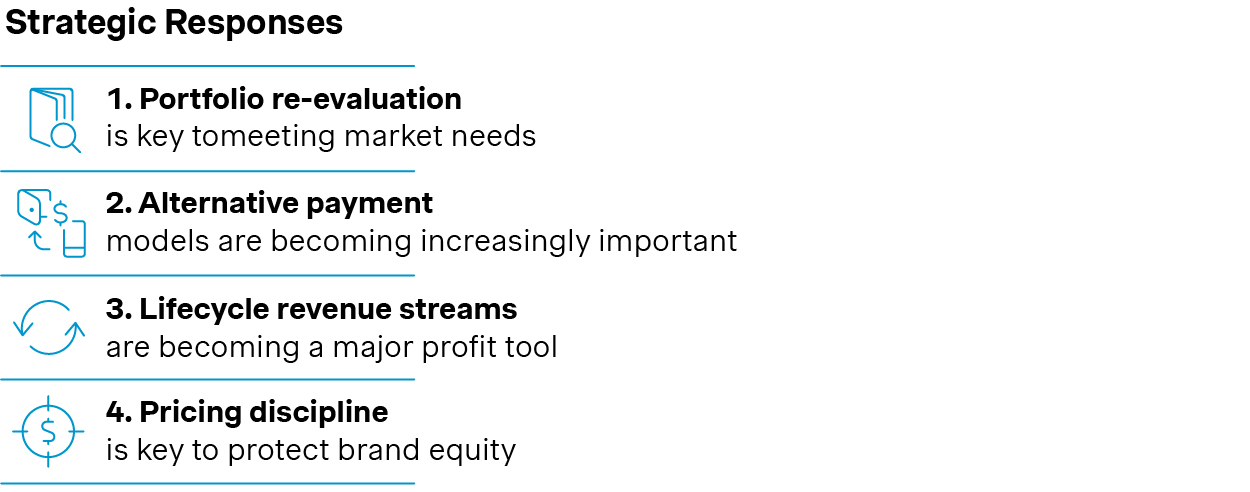
How manufacturers are adapting to this new landscape
As market dynamics evolve, durable goods manufacturers are rethinking their portfolio and business models. Rather than relying solely on the existing portfolio and new product sales, companies are increasingly focusing on sharper portfolio segmentation, alternative ownership and payment models, lifecycle revenue streams and stronger pricing disciplines as key drivers of growth. Four strategic levers are emerging across the durable goods industry.
Reevaluating and repositioning the portfolio
The traditional consumer is pushed to extremes in terms of willingness to pay, either moving to the value for money segment or the premium segment. This move leaves manufacturers that do not have a clearly defined offering for either of these segments with something that is neither fish nor fowl. Durable goods manufacturers should either clarify the offer and target their messaging accordingly or invest in addition to the existing portfolio that more clearly focuses on either end of the market.
Manufacturers will find greater success by developing a clearer value proposition for either premium or value-oriented segments, where consumer demand is becoming increasingly concentrated.
Expanding recurring and lower-upfront payment models
As consumers become more cautious about large one-off purchases, alternative payment and ownership models are becoming increasingly important within durable goods. Financing solutions, subscriptions, leasing, rental models and “Durable-as-a-Service” offerings can lower the upfront cost for consumers while improving affordability and flexibility.
For manufacturers, the strategic value extends beyond affordability alone. Subscription and service-based models provide greater access to customer data, create opportunities for upselling and lifecycle monetization, and reduce dependence on volatile replacement cycles and promotional sales peaks.
Building lifecycle revenue streams beyond the initial sale
As demand for new products becomes less predictable, manufacturers are increasingly expanding into lifecycle-based revenue streams beyond the initial transaction. Aftermarket services such as repairs, maintenance, spare parts, upgrades, installation, extended care and refurbishment are becoming more strategically important across the durable goods industry as consumers keep products longer and expect support throughout the lifecycle. These activities also strengthen customer retention and brand loyalty throughout the product lifecycle.
Manufacturers that actively participate in these secondary markets are better positioned to preserve brand equity, extend customer lifetime value, and maintain greater control over pricing and product quality throughout the lifecycle.
Maintaining pricing discipline and protecting and investing in brand equity
As longer replacement cycles and more selective consumer spending reshape demand, many durable goods categories face growing risks of overproduction and excessive promotional activity. While heavy discounts may support short-term sales, sustained promotions can quickly erode margins, weaken brand perception, and train consumers to wait for discounts.
Effective forecasting, inventory management, and promotional discipline are becoming increasingly important sources of competitive advantage for manufacturers. Stronger direct-to-customer capabilities can support this by providing greater control over pricing, customer communication, and reducing reliance on retailer driven discounting. Stronger direct-to-customer ecosystems also provide richer consumer data, enabling more precise pricing, better targeting and higher conversions, key advantages in a market where margins are under pressure.
Conclusion
In short, the durable goods industry is undergoing transformation, driven by shifting macroeconomic dynamics, evolving global trade patterns, and changing consumer behavior. These developments are creating new opportunities for manufacturers to strengthen their positioning, build resilience, and unlock growth. Companies that successfully combine clear differentiation, strong value communication, and disciplined commercial execution will be best positioned to benefit.