
In the first article of this series, we argued that GenAI in professional services is more Roman Empire decline than dinosaur extinction: slower and messier than the initial hype suggested, but no less consequential. In the second, we argued that the commercial answer is to move from tennis to golf – from one dominant price model, time-based billing, to a toolkit of price models matched to different service archetypes. The obvious next question is execution. How does a partner-led professional services firm actually build that toolkit and make the AI pricing transformation stick?
In many firms, the debate still gets stuck at the wrong level. The question is framed as whether the billable hour is dead – it is not; whether fixed fees are the answer – it depends; or whether clients are ready for something new – they say they are, but then often stick to the status quo. None of those questions is quite right.
The price-model question has been a key one over the last two years. But identifying a new price model alone will not get firms where they need to be. Take the example of fixed fees. Simply “moving to fixed fees” is not enough. Not all fixed fees are created equal. A fixed fee reverse-engineered from partner hour estimates is still the billable hour in a different suit. It will continue to pass efficiency gains through to the client, while central AI investments often remain invisible in local pricing decisions. The answer is not the price model in isolation. It is a commercial system that helps firms select the right model in the right situation, calibrate price when value rather than time is the yardstick, translate use cases into monetization archetypes, and equip the partnership to sell and defend those models in the market.
What needs to be put in place
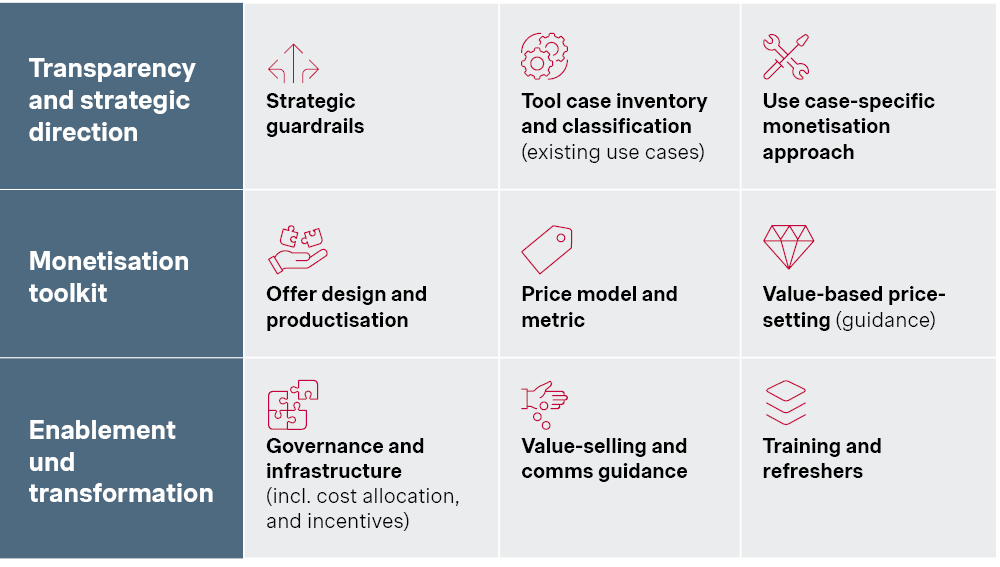
The benefits of GenAI will either show up in higher margins or be passed through to clients rather than lost through revenue erosion. There are nine steps across three layers: transparency and strategic direction, the monetization toolkit itself, and the enablement needed to make the change stick.
GenAI Value Realization Framework
Transparency and strategic direction
Not every AI-driven efficiency gain can or should be monetized directly. Some capabilities are table stakes - simply the cost of staying relevant. Others create genuine opportunities for margin premium, revenue uplift, or increased share in priority markets. Firms need explicit guardrails on where they want to play: more bespoke, human-led advice; more productized outputs; or a deliberate mix of both.
In most professional services firms, tech-augmented use cases have emerged in different parts of the business without a central strategy. The right unit of analysis is not the tool itself but the use-case archetype. The same tool may act as an invisible internal copilot in one service, a semi-automated workflow in another, and a client-facing proposition in a third. Those three situations do not require the same monetization response. Firms need a single inventory of existing use cases, grouped into a small number of key archetypes that can be addressed with a distinct monetization strategy.
Once the archetypes are defined – typically three to five – each needs a distinct monetization strategy. Some tools may be best used as door-openers and not priced individually because they generate downstream advisory revenue. Another archetype may consist of services that can be codified or productized into a clear output and therefore moved to output-based fixed fees – for example, a fee for each contract generated by technology with a human in the loop. Others may involve tools the client can access directly, with ongoing benefit, and therefore require subscription logic.
Monetization toolkit
When moving to fixed fees – for example, output-based – productization matters. Productization does not mean pretending every matter, project, or engagement is identical. It means creating enough structure to sell defined outputs and scope boundaries rather than effort. Clear scoping is imperative. In a tech-enabled service world, there is also greater variation in how technology can be bundled into the offer, and concepts such as offer versioning (e.g., multiple scope options) become increasingly important. Some firms use different versions that vary the human-in-the-loop component, allowing them to pitch a range from lower-cost, tech-automated options to higher-priced, higher-touch offerings. Commercial design needs to lead, not lag, because it is hard to industrialize delivery for something that has never been clearly packaged.
This is where the golf bag gets assembled. The right answer depends on how client value and delivery economics actually scale. If AI primarily improves internal efficiency but the client barely notices, time-based models may persist, perhaps supplemented by higher rates or a technology surcharge. Where tasks are repeatable and can be codified or productized, transactional pricing can work (price per task). Where outputs are well defined, output-based pricing is often stronger (price per output). Where usage varies over time, subscriptions or credits can make sense. Where the impact on the client is measurable and attributable, outcome-linked models may be appropriate. The key is not creativity for its own sake. It is matching the metric to reality.
Selecting a price model is only half the job. Firms also need guidance on actual price levels. For some propositions, that may mean central price cards or list prices – something that until recently would have seemed alien in professional services, given the bespoke nature of most engagements. Yet some leaders, particularly in accounting and tax, have already built internal list prices for key services to ensure that prices are anchored to those benchmarks rather than to falling time estimates. For others, bottom-up costing may still be appropriate, but with more explicit value-based premiums – that is, more differentiated margin mark-ups layered on top of cost. This again requires clear guidance on when to apply which mark-up. The point is not to eliminate judgment but to anchor it more clearly in value rather than defaulting back to hours. Without that discipline, even the most promising new model will quickly drift back into time-derived pricing.
Enablement and transformation
This new pricing guidance requires more centralized pricing authority. Once firms move away from decentralized pricing based on what an individual partner thinks – especially when costs extend beyond that partner’s team and pricing becomes more complex because it relies on value proxies – stronger governance becomes essential. Where partners previously could price largely as they wished within broad boundaries, the swim lanes are narrowing. This is part of the broader shift from professional services as a loose franchise to professional services as a more coordinated commercial system. Internal cost allocation matters too. Many AI investments sit centrally, while pricing decisions sit locally with partners. That is a recipe for giving away value and under-recovering cost. If underlying economics are invisible, the behavior will be wrong. Incentives need attention as well.
One of the most common stalemates – firms say clients only buy hours, while clients say firms only sell hours – will not break without better commercial narratives. Partners need to be able to explain why a different model is fairer, what risk it removes for the client, how it links more directly to the output or outcome being purchased, and why it should not simply be translated back into a grade-and-rate grid. That is especially important when procurement functions try to force new propositions into old comparison mechanisms.
Finally, the toolkit is only useful if the people who price and sell the work know how to apply it in live opportunities. Training cannot be a one-off theory session. It needs to be practical, repeated, and linked to real offers, real negotiations, and real post-mortems. Anything less only produces awareness, not behavioral change.
Taken together, these nine elements amount to a commercial transformation – which explains why so many firms freeze at the starting line. The task feels too broad, too political, and too decentralized. But the real mistake is to assume that everything must move at once.
How to get started: Newton’s laws of motion in a partner-led firm
We have seen many firms struggle to put this structure in place. While they understand the principles in theory, they often struggle to make meaningful progress in practice. The challenges are common. Moving a group of partners is not easy. But Newton’s laws of motion provide a useful way to think about how to approach the problem.
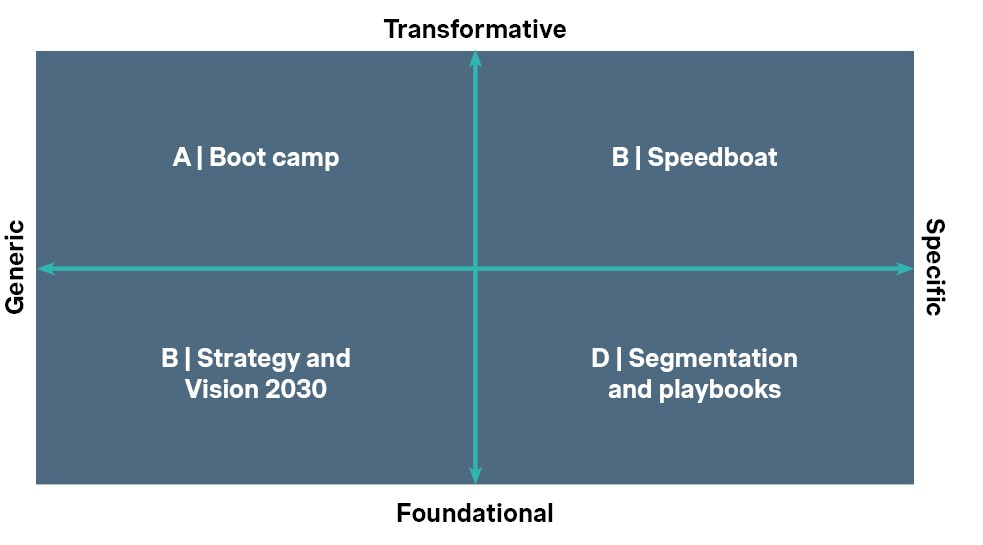
The matrix above is useful because it separates two different dimensions: generic versus specific, and foundational versus transformative measures. That creates four legitimate entry points:
- “Strategy and Vision 2030”: Developing a strategic foundation for GenAI and commercialization
- “Segmentation and playbooks”: Implementing the full monetization guidance across archetypes firm-wide
- “Boot camp”: Training a group of partners as internal champions, so they can act as multipliers
- “Speedboat”: Optimizing the monetization approach for selected pilot use cases
All four matter, but in many firms, the most effective starting combination is boot camp plus speedboat. One builds broad commercial capability across practices. The other creates concrete proof in a focused set of AI-augmented services. And the logic becomes clearer when viewed through Newton’s three laws of motion.
First law: Inertia is real
Newton’s first law tells us that an object at rest stays at rest unless acted upon by an external force. The same is true of the billable-hour model.
It is embedded not only in pricing, but also in time recording, compensation, procurement expectations, staffing models, and habit. A slide deck does not move that. A memo does not move that. Even a strong strategic case often does not move that.
A boot camp creates the initial force – not as a broad awareness program for the whole firm, but as a focused capability-building effort with respected partners and commercial leaders from key service lines who can become internal champions. Crucially, the boot camp should work on real offers and real client situations. The output should be practical: early decisions on offer design, price metrics, price levels, and negotiation guidance.
In other words, the boot camp should do two things at once: train the champions and build the first pieces of the new commercial model.
Second law: Acceleration depends on force relative to mass
Newton’s second law tells us that acceleration depends on force relative to mass. Large professional services firms have a lot of commercial mass: many practices, many exceptions, many highly autonomous decision-makers, and many legitimate differences between services.
That is why trying to redesign the entire firm at once is usually the surest way to slow down. The better answer is to reduce the mass of the problem.
This is where speedboats come in. Choose a small number of tech-augmented use cases or services with clear value potential, sponsor support, manageable delivery risk, and enough repeatability to redesign the commercial model end to end. For each speedboat, work through the full chain: offer design, price model, price metric, price level, governance, and value communication.
That creates tangible proof points. It also creates learning. Which value messages resonate? Which metrics are easiest for clients to understand? Where does procurement push back? Which internal cost items need to be allocated differently? One successful speedboat makes the next one materially easier.
This is also how firms avoid the deer-in-the-headlights problem. The goal is not to change every price model tomorrow. The goal is to get moving in the highest-potential areas and build momentum through evidence.
Third law: Every action triggers a reaction
Newton’s third law tells us that every action creates an equal and opposite reaction. Pricing transformation will trigger reaction everywhere.
Partners will say their work is too bespoke. Clients will ask for comparability with legacy proposals. Finance will worry about margin leakage. Delivery teams will fear that productization means commoditization. Practice leaders will insist that their service line is a special case.
None of this is surprising, and none of it means the strategy is wrong. It means the change is real.
The answer is to prepare for the reaction. Governance is part of that answer. So are internal cost allocation, value-selling guidance, incentives, and refreshers. Without these elements, even strong pilots remain isolated exceptions. With them, first reactions become manageable friction rather than a reason to revert to the status quo.
This is precisely why boot camps and speedboats are so complementary. The boot camp creates a common language and a network of internal champions. The speedboats create practical commercial assets and early market evidence. One builds capability. The other builds credibility. Once both are in place, the more foundational quadrants – long-range strategy and detailed playbooks – become easier to complete on the back of real experience rather than theoretical debate.
In practice, the sequence is straightforward. Nominate champions from across the firm. Choose a first wave of high-potential speedboats. Use the boot camp to develop their commercial design. Launch with explicit guardrails and proposal support. Review what works, codify the lessons, and repeat. That is how a decentralized partnership begins to move like a coordinated commercial system.
What AI pricing is really changing
What AI is disrupting in professional services is the monetization model, not the expertise behind it.
The firms that win will not be those that simply buy the most AI tools. They will be the ones that decide what part of the AI-enabled value stack they want to own, how that value should be packaged, and how to bring a partner-led organization with them.
The billable hour is not dead. But its monopoly is.
Time becomes one club in the bag – not the whole game. The right move now is not to wait for perfect certainty, but to build the toolkit, launch the speedboats, train the champions, and start moving.
To find out more about this topic please contact our experts today.