
Here, proposals get made, prices get set, and deals are won
With awareness and interest secured, we now arrive at the bottom of the funnel (BOFU). This is where proposals, pricing, and final decisions come into focus, and where deals are made or lost. What separates winners now isn’t polish. It’s whether the proposal actually says something new, ties clearly to real business impact, and can hold up under internal scrutiny you’ll never get to sit in on.
Where we are in the sales funnel
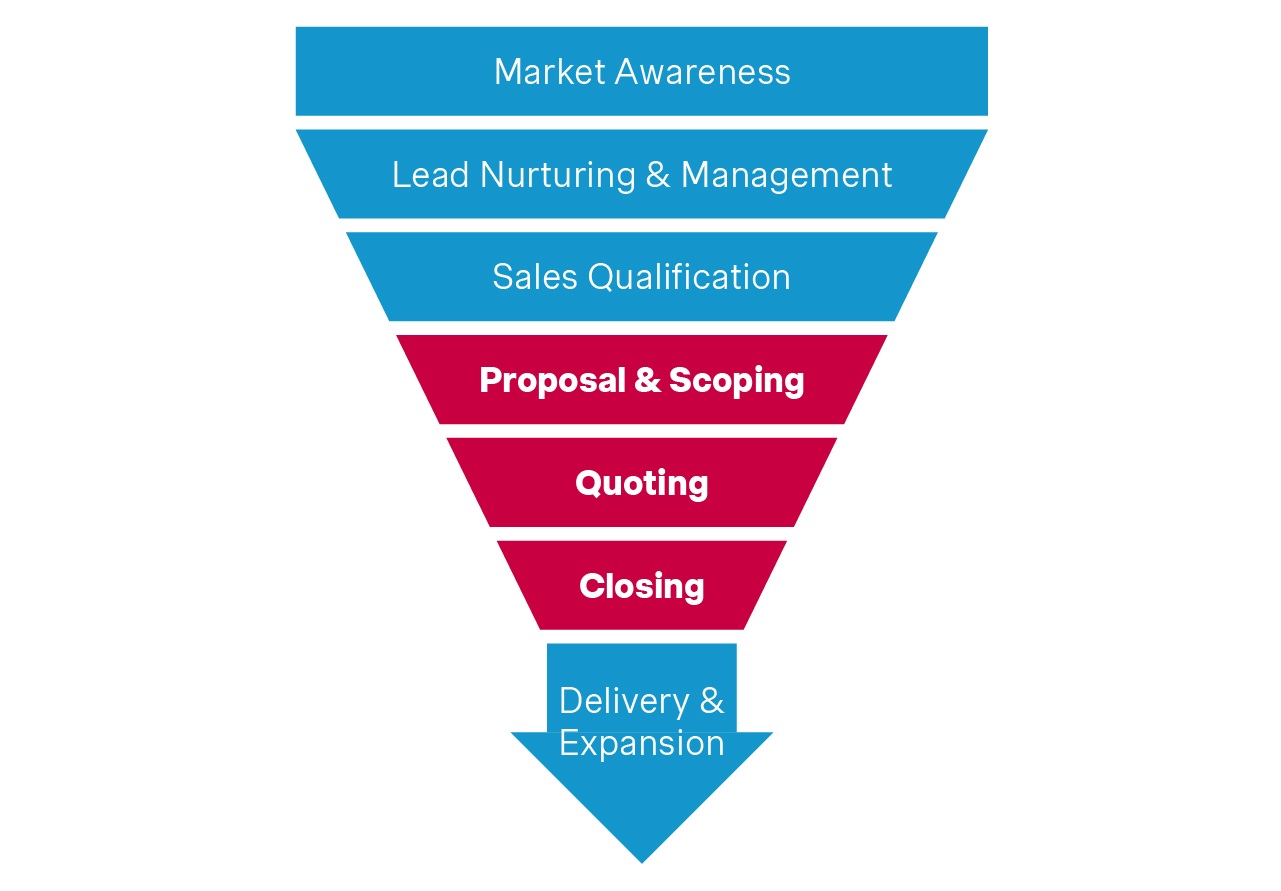
In the content ahead we’ll look at each of those moments, scoping, quoting, and closing, and outline practical ways to keep your firm’s value unmistakable.
Proposal and scoping when every deck looks the same
Once an SQL is qualified, this stage of the funnel used to be where the magic happened: smart framing and compelling stories that helped buyers see things in a new way. But now, the proposal process has been changed by AI. Templates and auto-generated language can make every firm’s proposal sound the same unless the thinking is truly original. Now that clients are leveraging AI tools to assemble RFPs, every proposal in the bidding process ends up looking the same.
If you’ve done your qualification effectively in the last phase, you should be working on much fewer proposals where you have a chance to win. And we recommend spending serious time on them.
In your proposals, be sure to embed something that clearly shows it could only have come from your firm, e.g., a methodology, a piece of proprietary data, a very specific case study that you explained in the intro calls, a way of framing the problem that no one else has used. Templates are fine, but it’s what’s inside them that drives a prospective client’s decision to work with you.
Take the time to walk your prospect through your proposed approach. Get their buy-in before building the proposal to create the sense that it was custom-made for them. Like we said earlier, if you did your qualification correctly, you should be able to create a unique proposal that is customized to the client’s specific needs.
Quoting when buyers push back on price
Pricing is where things get especially uncomfortable. A quote that once reflected a firm’s expertise and depth of effort now gets filtered through a lens of perceived automation. Clients ask, “If AI is going to help build this, why am I paying a premium?” Without clear outcome-based anchoring, pricing feels arbitrary and inflated. Cost-plus logic also breaks down. Unless firms can draw a clear line between their fees and the client’s end value, quoting becomes a difficult negotiation rather than an easily justifiable investment.
The key word here is ‘value’ and here’s what that means in practice:
- Know your value. What impact do you create? Focus on outcomes over level of effort.
- Understand what your impact is really worth to clients. What is it worth in real terms: revenue, efficiency, speed, credibility, etc.?
- Make sure your pricing reflects that value. That means the price point, the metric (e.g., per outcome, per phase, per hour), and the model (e.g., time and materials, fixed, performance-based) should all align.
- Learn how to sell that value. Don’t just defend it but, sell it. You have to be able to explain it in their language, with their numbers, and on their terms.
If your price isn’t clearly connected to the value and outcomes you’re delivering, AI gives buyers an easy reason to say, “this feels expensive". When that pushback comes, it’s natural to start defending the work by listing the hours involved, the seniority of your team, or the long list of deliverables. But the moment you do, the conversation shifts from outcomes to inputs. And once your work is framed that way, it starts to look interchangeable.
Instead, change the narrative in the following ways:
- Re-anchor on outcomes. “This isn’t just a deliverable, it’s the decision confidence your team needs to move forward with X.”
- Reposition the cost. “This is a $200K investment to address a $40M problem.”
- Break the quote into value layers. Show which parts drive results, mitigate risk, or create speed. Let them downgrade but make it clear what they would lose.
- Provide options. A best practice is to present your proposed offering such that it shows varying levels of investment and resulting outcomes. This allows the client to self-select into the option that best meets their needs and allows for a meaningful discussion on trade-offs.
And finally, don’t negotiate against yourself. If your value is real and clearly articulated, you don’t need to justify the price. You just need to make sure the client understands what they’re buying.
Closing when you’re getting benchmarked to death
Even if your proposal lands well and your quote is within range, there's another hurdle and it's one you probably won’t be in the room for. Clients are increasingly using AI or procurement tools to benchmark vendors side-by-side, compressing weeks of decision-making into just a few clicks.
They don’t need a fancy platform and just uploading proposals into a program will generate summary tables, comparisons, and pricing matrices quickly. What used to rely on trust, relationships, and nuance is now reduced to checklists and automated evaluations. And unfortunately, a great pitch can still lose to a cheaper firm or one that simply looks similar on paper.
Winning the pitch is no longer enough and, you have to win the internal comparison, too.
Here’s how to do it:
- Design proposals that survive internal benchmarking. In professional services, it’s rarely one buyer but, a committee. Your proposal won’t just be read, it’ll be dissected, summarized, and passed around. Assume it’ll be uploaded into a procurement tool or AI chatbot, and build for that. Use crisp, outcome-driven language that holds up when stripped of context. Make sure your impact is still obvious, even in bullet form.
- Create a “why us” slide. After the meeting, your contact becomes your salesperson. Give them a simple, visual slide or summary that clearly states why you’re the right choice, backed by impact, uniqueness, and fit. Make it easy for them to make the case internally.
- Preempt the procurement checklist. Ask early: “How will this decision be evaluated and who will be reviewing it?” Then shape your proposal around those criteria. If procurement is using a scoring system or template, design your content to win within their format. Make key sections like price, impact, and references impossible to miss, skip, or misinterpret. Be sure to treat structure and logistics as part of the proposal strategy.
- Don’t just describe what you’ll do, demonstrate the value it delivers. Instead of saying, “We’ll conduct stakeholder interviews”, say, “We extract decision-shaping insights that reduce misalignment and accelerate execution.” Clients don’t buy activities but outcomes. Since AI has created a world of sameness, the differentiator isn’t necessarily what you do but, the value it creates. Every capability should come with a clear statement of why it matters to the client. Make that connection obvious and unmissable, especially when your proposal is being dissected line by line. This is the essence of value selling: make the connection explicit.
- Build in post-meeting reinforcement. Don’t let the conversation end with the deck. Follow up with a 24-hour recap email that reframes your approach, rearticulates the outcomes, and subtly counters the competition. This keeps your message alive while internal benchmarking is underway.
As you can see, differentiation today isn’t just about how you pitch, but about how your pitch holds up when you’re not there to defend it. So, even if you’ve nailed the pitch and priced for value, the real test begins after the deal is signed. Great execution isn’t always memorable, and if your impact isn’t visible, your client might not come back.
Contributing author: Doga Sarier
In case you missed it, you can still catch up with Part 1 and Part 2 of our series.