
Today, telcos are losing their power to differentiate, and brand is one of the few levers left to justify value. Yet, half of customers believe their provider does not offer good value-for-money – an issue that budget players are largely immune to as they fuel customers’ “fear of missing out”. Many operators still rely on a single-brand or legacy multi-brand model, effectively conceding the budget segment to MVNOs. In the first of four instalments, we draw on our Global Telecom Study 2026 – 35 markets, 18,000 consumers – to explore how brand portfolio strategy drives commercial value and where it matters most.
Telcos are not losing on price – they are losing on value
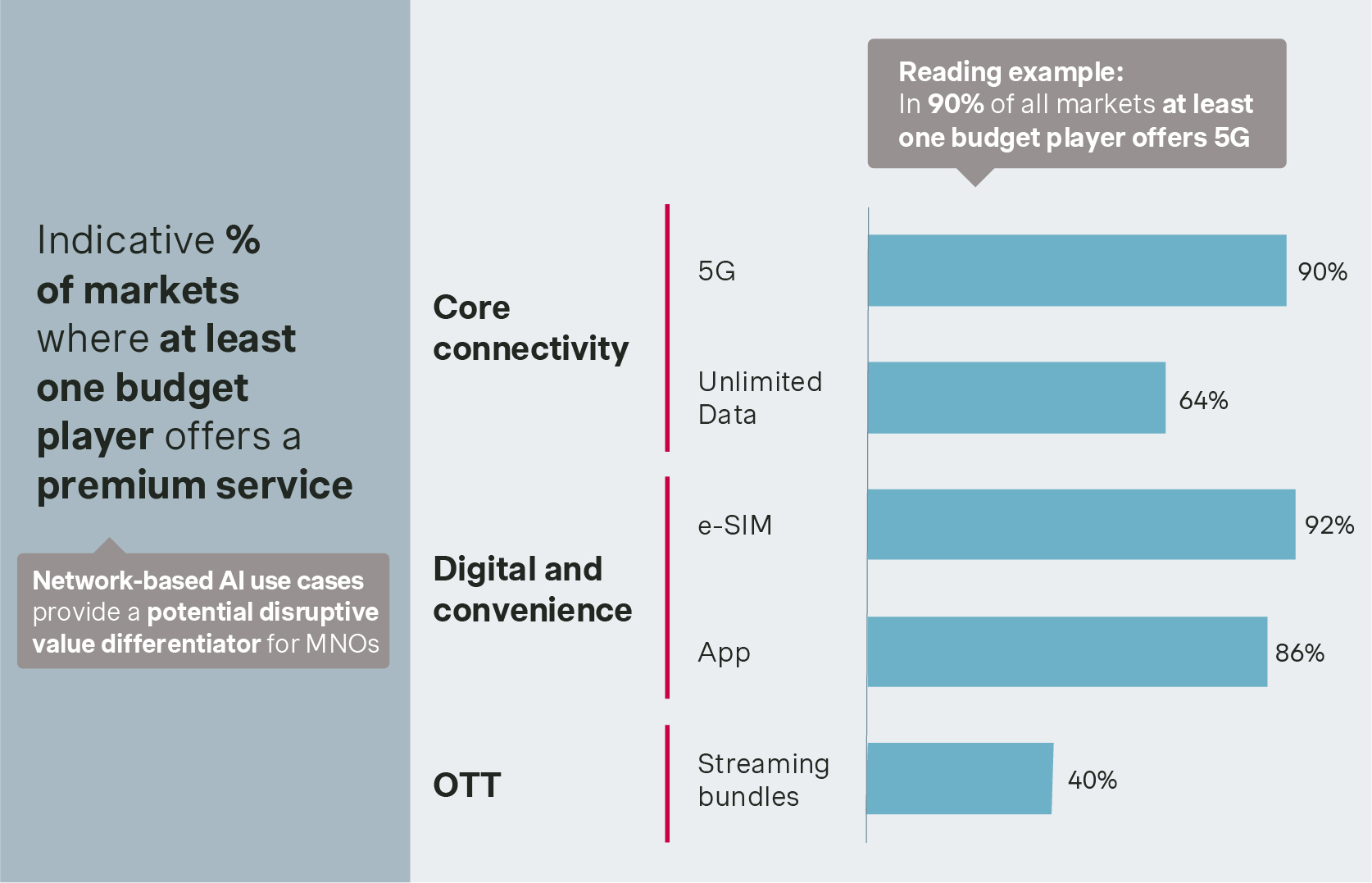
Telco’s value perception is broken. Connectivity is getting commoditized, features that once justified premium positioning are becoming a hygiene factor, and low-cost players – not technology leaders – now set the competitive price benchmark. ARPU is declining across segments, with the premium segment down 2.6% CAGR since 2024. Ninety percent of markets now offer budget-tier 5G alongside widespread access to eSIM, unlimited data, and streaming services.
Customers have noticed: only around half believe their provider offers good value-for-money. MENA and Latin America outperform more mature markets like Europe and North America significantly, where the challenge is less a pricing problem than a brand positioning failure, with operators simply not making a convincing case for the premium they charge. The study results prove that operators with a well-structured brand portfolio build awareness, recognition, and appeal across customer segments.
Brand still matters, but not everywhere
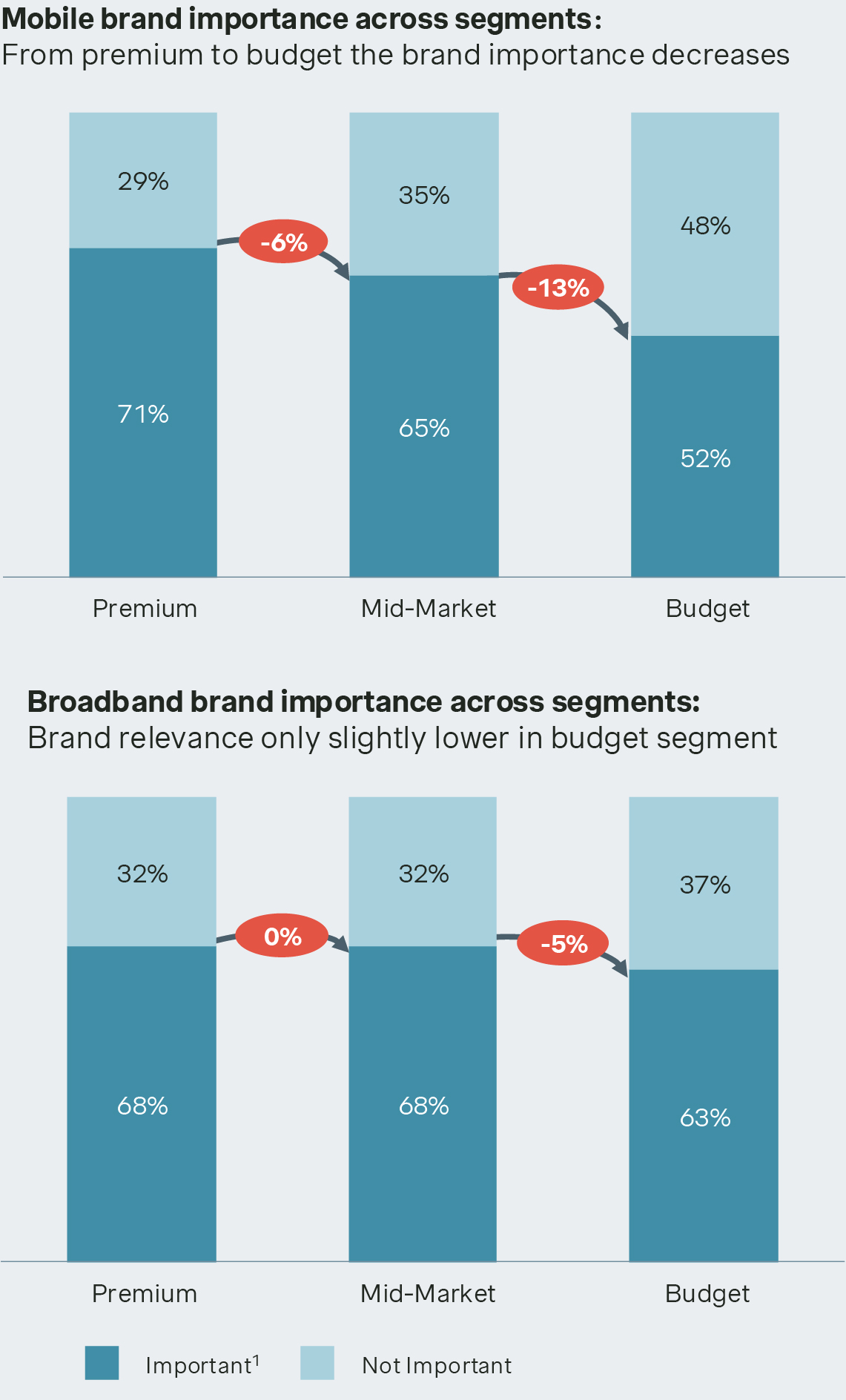
Our Global Telecom Study 2026 also shows that between 50-70% of customers cite brand portfolio as a key factor in provider choice.
But its influence is becoming more concentrated at the top end of the market. The divergence is sharpest in mobile: in low-end segments, brand is increasingly irrelevant and price and plan terms dominate. In broadband, the direction is the same, though less severe.
A single premium brand cannot serve the full market. Competing for price-sensitive customers under the same brand can undermine its premium credentials – customers may no longer see the higher price as justified. But avoiding the budget segment entirely leaves a big customer segment to MVNOs and low-cost challengers. Ultimately, this leads to overstretched portfolios that lack a distinct price/value proposition. Well-defined, (re)positioned brands can complement each other and enable operators to extract both volume and value in highly competitive markets.
Where brand fits in the competitive stack
Our competitive advantage matrix, which compares the importance and performance of operators across a range of attributes, highlights where telcos can meaningfully differentiate and how they currently perform across key attributes.
Premium providers lead on the most important value drivers, but not by enough to discourage switching or fully justify a price premium. Network quality, internet speed, and price continue to be table stakes – baseline requirements before brand has any leverage. However, they no longer create meaningful differentiation, as all players consistently score high across them.
Against this backdrop, brand builds on these fundamentals. It does not replace functional performance, but once expectations are met, it shapes how customers interpret quality, trust, and willingness to pay – giving operators a a competitive edge.
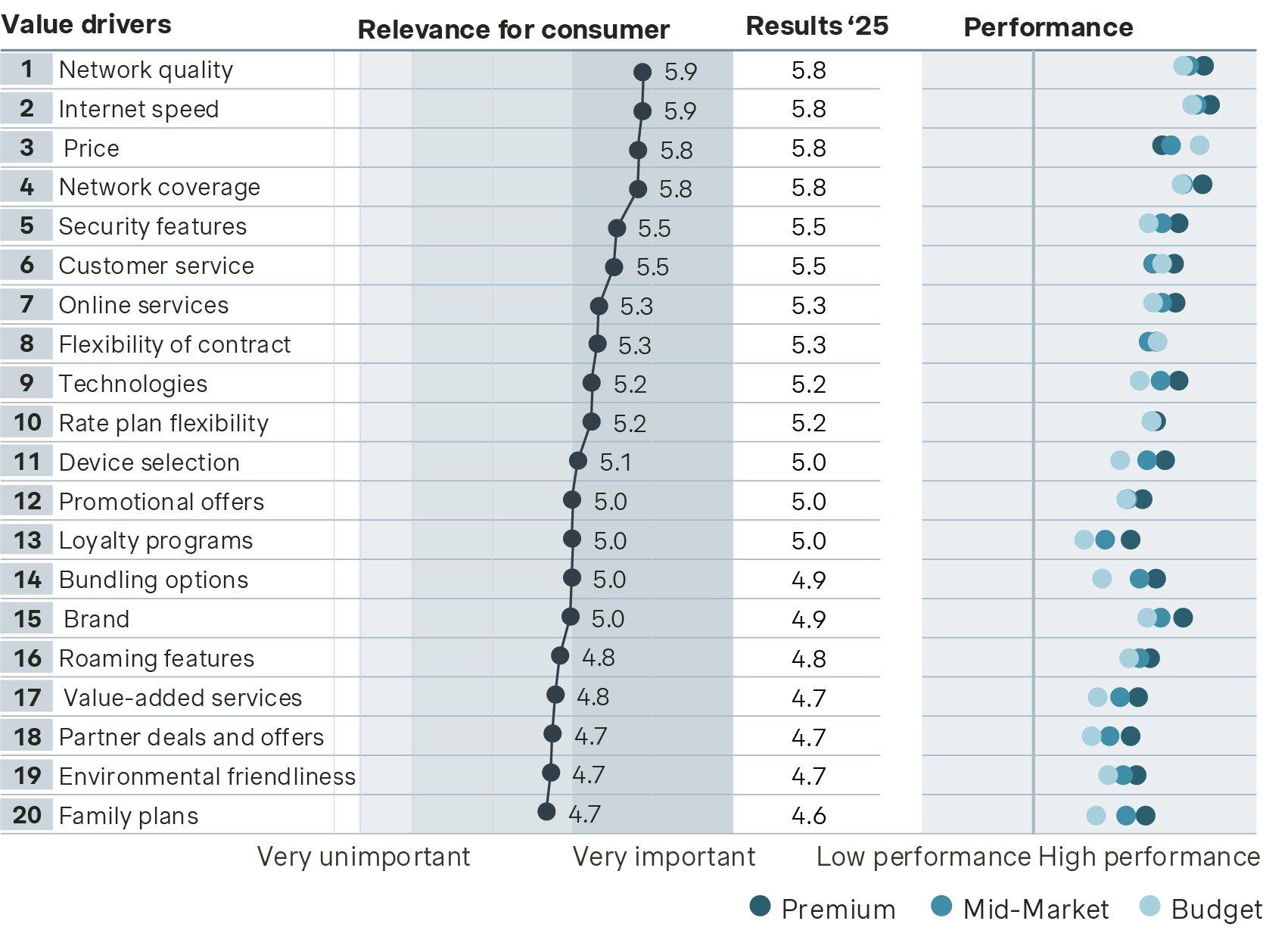
Security is emerging as a clearer point of differentiation. While it ranked 15th and 21st respectively in last year's study, it has moved up sharply in 2026 to fifth place. For premium operators, this represents a near-term opportunity to pull ahead on a dimension low-cost players cannot credibly match.
Sub-brands vs. MVNOs: The portfolio gap
The industry is responding to market segmentation, but unevenly. Our analysis of more than 500 operators globally shows the average telco manages 0.8 sub-brands, with significant regional variation.
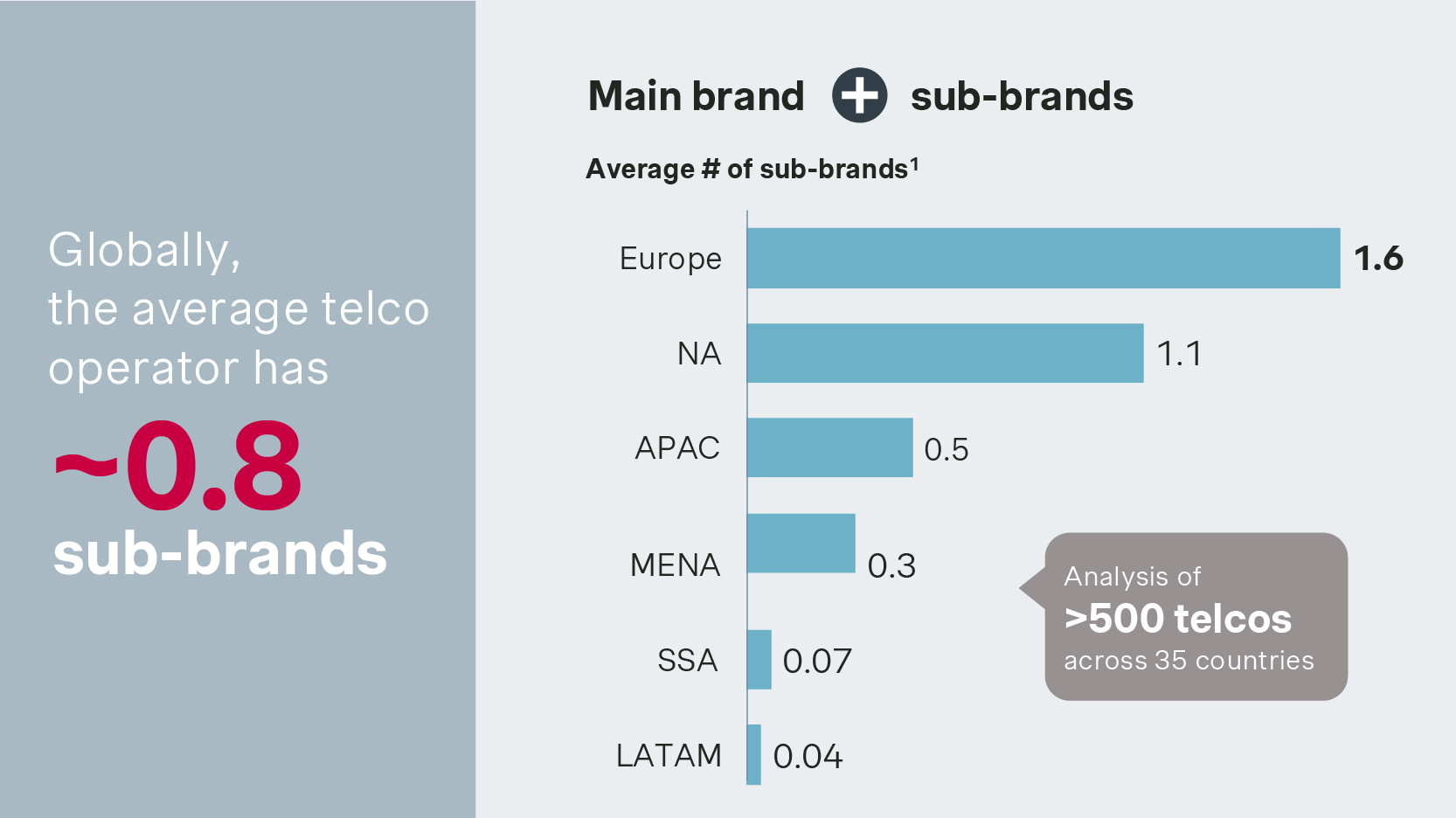
Mature market operators have moved toward multi-brand models in response to price/value pressure, resulting in a crowded landscape of historically developed brands that often lack clear alignment and distinct target segments. By contrast, emerging markets tend to rely on more single-brand coverage, creating gaps in lower-value segments. These gaps are most visible in the budget segment, which 60-80% of MVNOs target. In most regions, telco sub-brands do not come close to matching this presence. For example, Europe has 102 MVNOs against 92 sub-brands, while Latin America has 22 against 1.
The strategic response is twofold: either define clear brand roles within a consistent multi-brand strategy or sharpen value differentiation within the core brand. Without a clearly positioned sub-brand to compete in lower-value segments, telcos risk conceding price-sensitive customers to MVNOs rather than retaining them within their own base at a lower price point.
Building a second brand requires deliberate steps: distinct positioning, value proposition, channel logic, and customer retention strategies – all structured to avoid cannibalizing the core with its primary customer base and pricing power. Our multi-brand strategy framework covers all eight commercial dimensions operators need to manage, from brand north star to KPI dashboards.
What customers want vs. what telcos project
Telco customers largely associate their current providers with functional and trust-driven brand archetypes.
When asked what they want from a new provider, the picture shifts. The preferred archetypes skew toward the Expert (37%), the Protector (37%), and the Helper (34%).
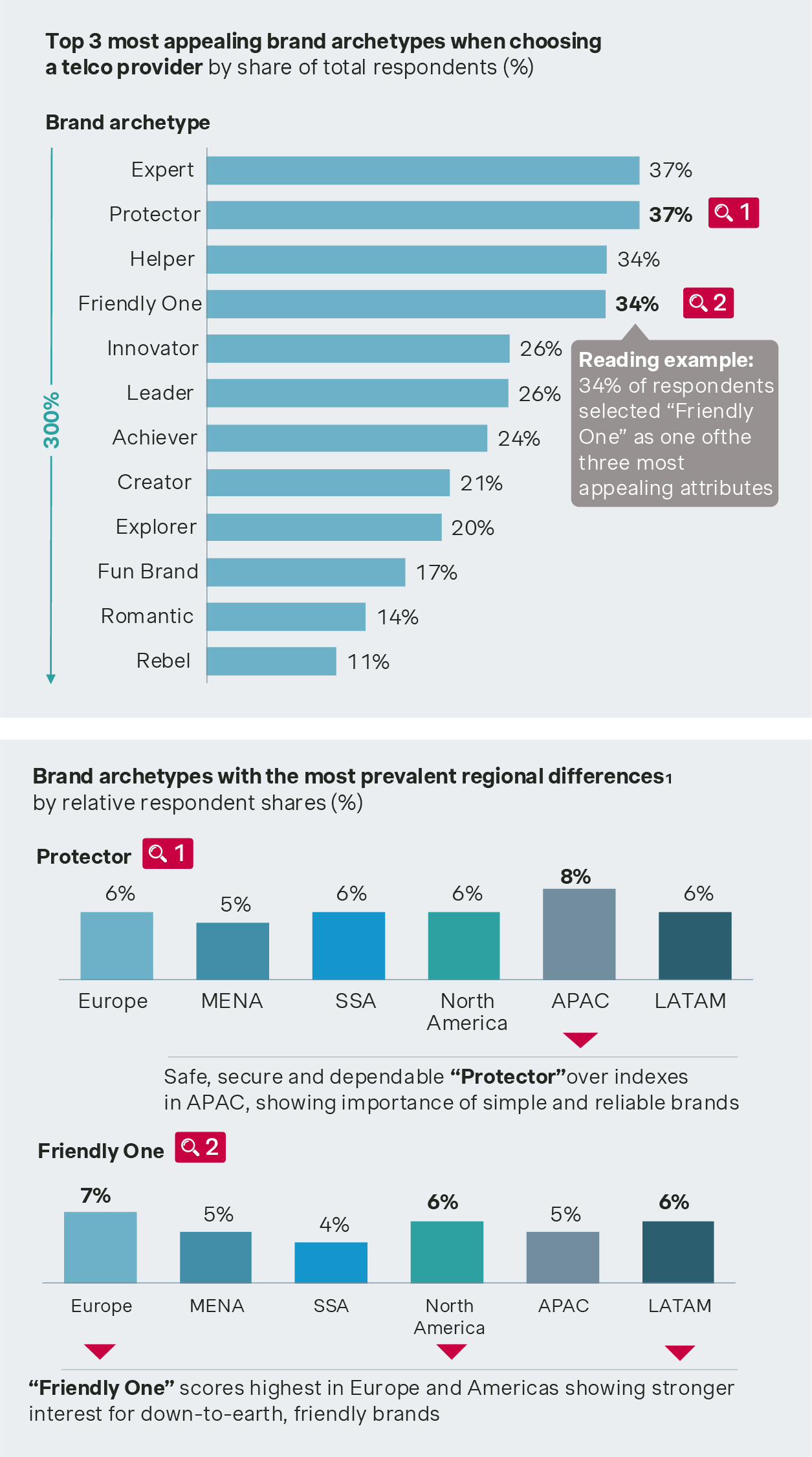
Regional differences matter and should inform portfolio decisions as what works in a high-trust mature market does not automatically translate to a price-sensitive emerging one. The Friendly archetype is strongest in Europe (7%), North America (6%), and Latin America (6%).
The Protector archetype is the one to watch. As data privacy, security concerns, and digital trust rise on the customer agenda, Protector positioning offers a defensible premium rationale grounded in functional need and harder for low-cost players to replicate than price or content bundling. Yet most telcos fail to fully deliver on this positioning, resulting in a disconnect with customer expectations and a dilution of perceived value.
Connecting brand strategy to the full customer lifecycle
Brand portfolio strategy is the foundation, but it is only the starting point. Maximizing customer lifetime value (CLTV) requires a connected view of how brand, customer acquisition, base management, and retention interact.
This is the logic behind the inflow, base and renewal, and outflow (IBRO) framework. While it is not a ready-made solution, it is our structured approach to finding one, to aligning these four dimensions around a unified, value-based commercial strategy.
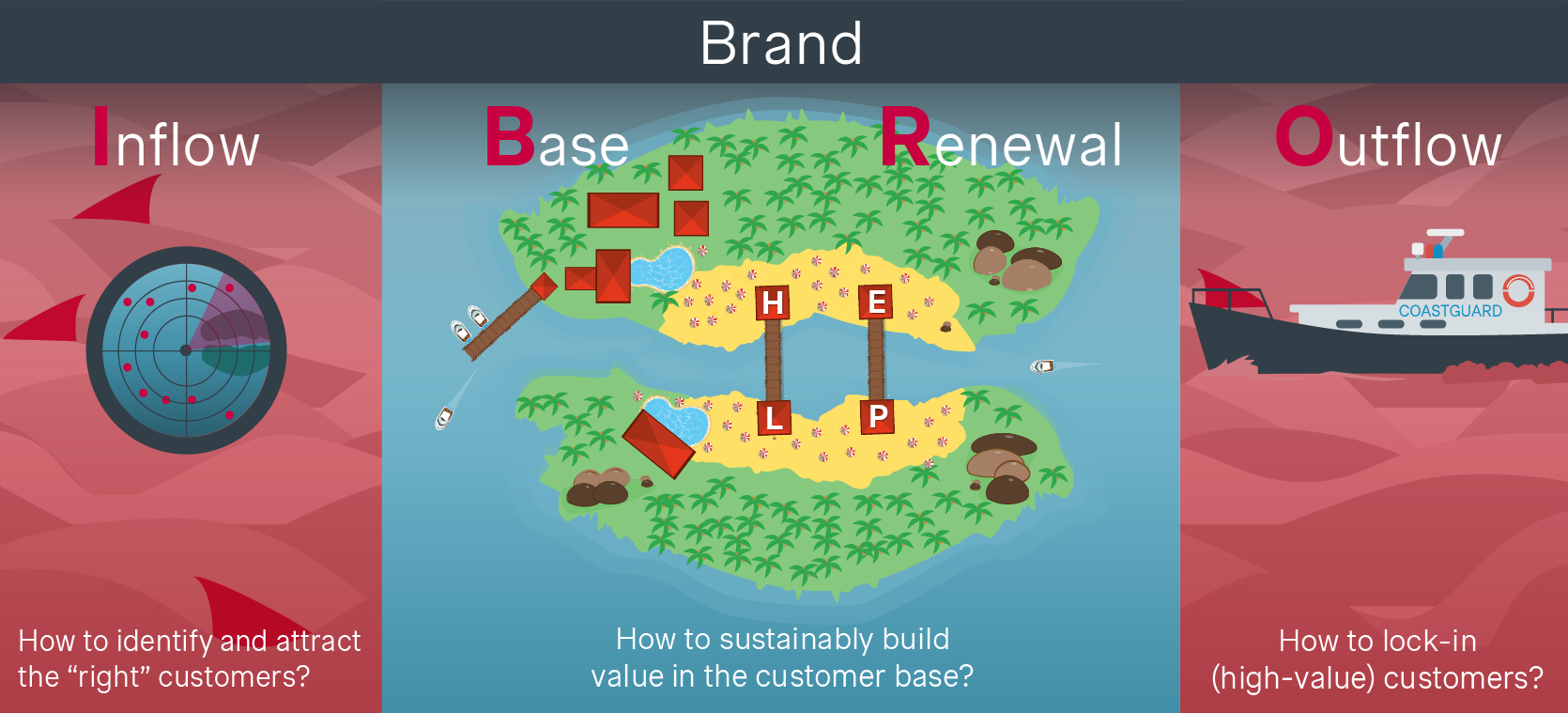
The remaining parts of this series will examine each dimension in turn. Part two focuses on customer acquisition: how operators can attract the right customers from the outset, rather than compensating for poor targeting later.
Click here to read blog 2: inflow
Click here to read blog 3: base
Click here to read blog 4: outflow
Interested in our 2026 Global Telecommunications Study results in more detail?
Form placeholder. This will only show within the editor