
Medtech and diagnostics companies face rising costs, intensifying competition, and increasing pressure to deliver smarter, faster commercial decisions. Yet many still manage revenue through fragmented tools and siloed processes. This final article in our ‘revenue management in medtech and diagnostics’ series brings together the full picture: how a business-first, technology-enabled approach can transform the entire revenue journey: from lead to cash.
Revenue management has become a strategic battleground in the world of medtech and diagnostics. Rising cost, supply chain risks, and an intensifying competitive environment – often in tender-led procurement processes – have made commercial agility and efficiency just as vital as clinical excellence. Meanwhile, customers expect faster responses, transparent pricing, and consistent terms across markets, products, and channels.
Against this backdrop, Revenue Management have become the defining capability separating commercial leaders from laggards. Revenue Management is not merely software. It is an integrated ecosystem of strategy, people, processes, and technology that governs the entire revenue journey, from the initial lead to cash collection. The difference between pipeline and cash is measurable. The graph below highlights where revenue slips across each stage. Every gap represents value left on the table unless leaders intervene to protect it.
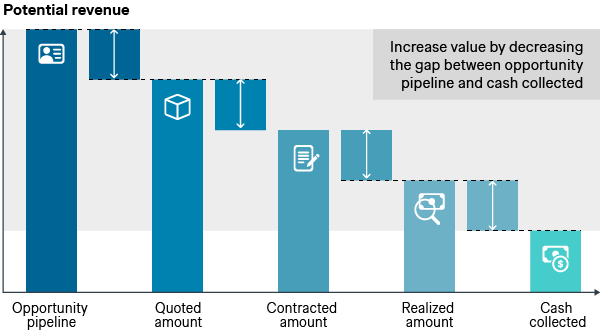
Source: Simon-Kucher insights
And yet, in most medtech and diagnostics organizations, this revenue journey remains fragmented. Tools rarely integrate, data is trapped in silos, and decision-making is sluggish, with no single owner of the end-to-end revenue process. The result: commercial strategies that fail to scale.
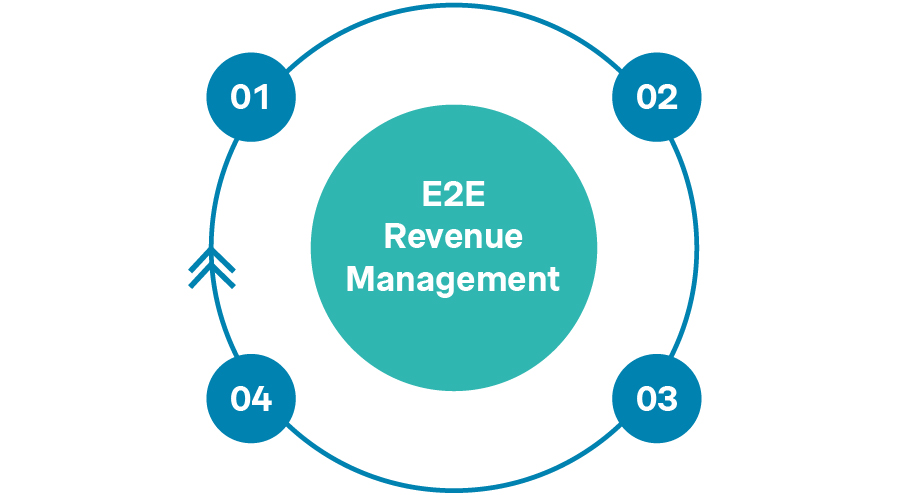
At Simon-Kucher, we structure revenue management around four interconnected pillars that collectively define the commercial lifecycle. When these pillars align, revenue management transforms from an operational system into a growth engine.
Why companies struggle with revenue management
Despite ambitious transformation programs, most companies still operate with low revenue management maturity. Their system may be advanced, but their commercial backbone is not. We consistently observe the same challenges across medtech and diagnostics players:
- No shared vision of how revenue should flow: Tools are bought as standalone fixes
- Disjointed data: Customer, product, and contract information live in different systems; teams don’t trust the numbers
- Broken hand-offs: Leads stall, quotes overlook contract terms, indexations go unbilled
- Tech before process: Software implementation is often rushed before business processes and requirements can be fully understood and documented, leading to needing workarounds as the tools don’t sufficiently support the process
- Limited insight loop: Dashboards describe what happened, but not what to do next; issues reoccur
The root cause is conceptual, not technical. Many companies treat revenue management as an IT project rather than a commercial transformation. The result: sophisticated tools running on outdated business logic – expensive to maintain and underutilized by the teams they were designed to empower.
Despite isolated improvements, most companies remain stuck at an intermediate maturity across the revenue lifecycle. The chart below shows uneven capabilities that prevent revenue from flowing end to end.
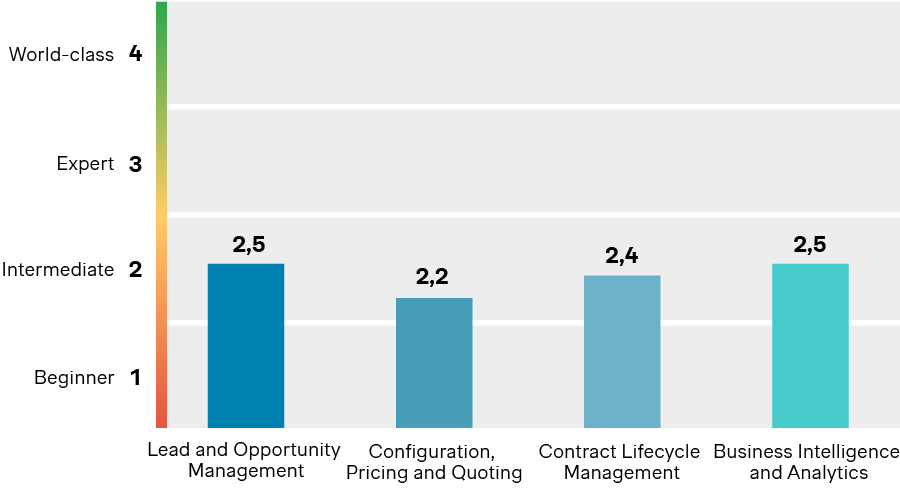
Source: Simon-Kucher survey of 25 global medtech and diagnostics companies
Why typical approaches fail
Over the years, we have seen two recurring patterns in revenue management transformations. Both fail for predictable reasons.
The IT-first approach | The project-based approach |
| Technology takes center stage | Stand-alone custom solutions step in |
| A global CIO invests in premium CPQ or CLM platforms, often in a single “big bang” rollout. Business involvement comes late – too late to shape pricing logic, approval workflows, or customer data structures. By go-live, users struggle with clunky screens, local teams revert to Excel, and customizations spiral out of control. | Local or divisional teams launch “quick win” projects in isolation. Each delivers short-term results, but without a shared foundation. The company ends up with multiple tools, parallel rebate trackers, and inconsistent customer hierarchies. Integration later costs more than the original projects, and change fatigue sets in. |
Both approaches fail because they invert the sequence of success: defining business needs before technology choices.
The Simon-Kucher approach: A phased end-to-end revenue management transformation
Sustainable success requires a business-first, technology-enabled approach: one that brings commercial clarity before IT complexity. Simon-Kucher’s phased approach ensures each step builds on the last, creating lasting impact rather than one-off fixes.
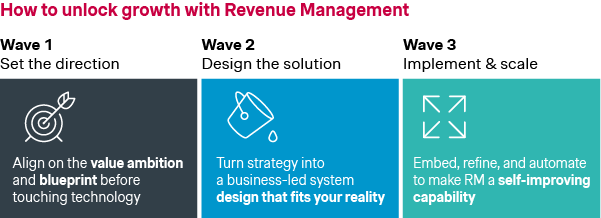
Source: Simon-Kucher insights
Wave 1: Set the direction
Lay the strategic and commercial foundation before touching technology.
- Assess your current state, benchmark against best practices
- Define the value creation ambition plan
- Align leadership on the business case and transformation roadmap
This phase establishes the “why” and the “what” – the commercial logic behind every future system decision.
Wave 2: Design the solution
Build the business-led architecture for how revenue management should work.
- Translate strategy into system logic, governance, and workflows
- Identify the right tool(s) and systems based on business fit and future scalability
- Define integration points, pilot design, and success KPIs
The aim is to create a solution that enables strategy, not constraints it.
Wave 3: Implement and scale
Turn the design into reality and embed continuous improvement.
- Pilot in selected markets, with commercial users driving iteration and adoption
- Roll out in waves, embedding analytics to detect margin leakage and refine rules
- Once stable, introduce automation and AI for elements, such as deal scoring, optimization, and indexation
At this stage, revenue management becomes a living capability, continuously improving accuracy, adoption, and margin performance.
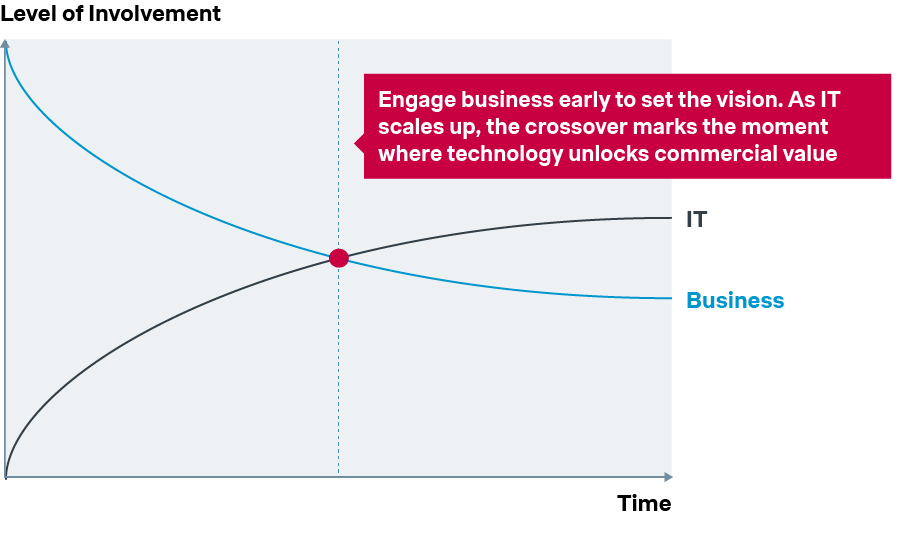
At Simon-Kucher, we help medtech and diagnostics leaders move from concept to capability – ensuring revenue management systems do not just operate but truly work for the business. By balancing commercial ambition with technical discipline, we build confidence early and avoid costly rework later. When Revenue Management is done right, business and IT involvement evolve in tandem. The graphic below illustrates the target state model for cross-functional engagement over time":
Source: Simon-Kucher insights
What success looks like
Companies that adopt a structured, business-first approach to revenue management systems quickly start to see tangible impact – both operationally and financially. Success is not defined by the number of tools implemented, but by the degree of commercial alignment and behavioral change achieved across markets.
When done right, revenue management evolves from a set of disconnected systems into a unified commercial backbone. Teams work from a single source of truth, supported by consistent pricing logic, clear ownership, and governance. This alignment addresses one of the most persistent challenges around inconsistent pricing and discounting across countries and business units, as highlighted in our article on offer and quote management.
Crucially, this approach limits unnecessary customization. With business rules and guardrails set early, organizations can deploy a regional or global revenue management stack that accommodates diverse market needs with minimal local tweaks. This shift cuts complexity while achieving a rare balance: process standardization and local flexibility working together – a harmony most IT-led transformations fail to deliver.
Equally, adoption and user engagement improve dramatically. In our monitoring and analytics work, we often see adoption rates climb when sales and commercial users co-design system interfaces and define relevant KPIs early. By integrating analytics into daily workflows, teams naturally shift from spreadsheets and local trackers to data-driven decision-making.
Over time, these effects reinforce each other:
- Greater transparency: Pricing and contracting follow a single, consistent logic from headquarters to the field
- Faster decision-making: Insights surface in real time and feed directly into quoting and renewal actions
- Stronger margin discipline: Leakages are identified early, and corrective measures become routine rather than reactive
- Continuous improvement: With structured data flows, AI-driven deal scoring and auto-indexation evolve from ambition to reality
In short, well-executed revenue management turns static tools into a living, learning system. It becomes the foundation for sustained growth and profitability – not just another IT project, but a commercial transformation that changes how revenue is managed, measured, and multiplied.
Quick checklist: You are doing revenue management right if…
The best way to assess your Revenue Management maturity is to look at your alignment – across people, processes, and platforms. Based on our experience, successful Revenue Management transformations achieve three outcomes: clarity, adoption, and improvement. So, what checklist must medtech and diagnostics leaders use to assess whether they are on the right revenue management path?
a. You are already doing well if…
| You run revenue through a single ecosystem | More than 80% of revenue flows through an integrated commercial software landscape, without reliance on Excel files or offline workarounds |  |
| Your commercial suite is widely adopted | CRM, CPQ, and CLM achieve over 80% active usage, with consistently high sales user NPS | |
| You execute lifecycle events without disruption | Contract renewals, indexations, and other lifecycle activities are handled proactively, without year-end crunches or manual fire drills | |
| Your organization works from one source of truth | A shared customer master, unified price logic, and transparent governance guide all decisions | |
| You embed continuous improvement | Benchmarking, prototyping, and feedback are part of daily operations | |
| You make decisions faster and smarter | Analytics drive actions, not just reports, creating a culture of insight-led management | |
b. If you are on the transformation journey, you are doing it right if…
| You lead it from the top | Revenue Management sits firmly on our leadership agenda, sponsored by a senior executive, not buried in operations | |
| You treat it as a transformation, not a project | It is viewed as a long-term commercial change program, not an IT roll-out | |
| Your business leads, and IT enables | Pricing logic, governance, and data foundations are defined before systems are selected | |
| You align end-to-end | Strategy flows coherently through logic, governance, data, and systems, with clear ownership at every step | |
| You engage key markets early | Global and local teams co-own the design, ensuring adoption and relevance across regions | |
| You pilot, learn, and scale | Improvements are built through test-and-learn cycles, not big-bang rollouts | |
If you cannot confidently answer “yes” to each of the six questions below, it may be time to reassess your approach. Based on our experience, these gaps indicate structural limitations in the revenue management operating model rather than execution challenges.
From fragmented fixes to sustainable growth
True revenue management is about commercial orchestration. When medtech and diagnostics companies build it the right way – business first, technology second – they not only fix revenue leaks but also create a self-improving commercial backbone that drives growth, transparency, and profitability.
If your organization is ready to elevate its commercial operations, Simon-Kucher can partner with you to design and implement a Revenue Management roadmap tailored to your business, ensuring your systems and strategy grow together. Reach out to us today.