Why great execution still feels replaceable to clients
We’ve followed the client journey from first awareness, through nurture, and deal making. Closing the contract, however, is only the halfway point. Now that every firm brands itself as “tech forward” and “results driven”, even flawless delivery may not be enough. Clients are beginning to ask: Could someone else have done this faster, cheaper, or with more insight?
Where we are in the sales funnel:
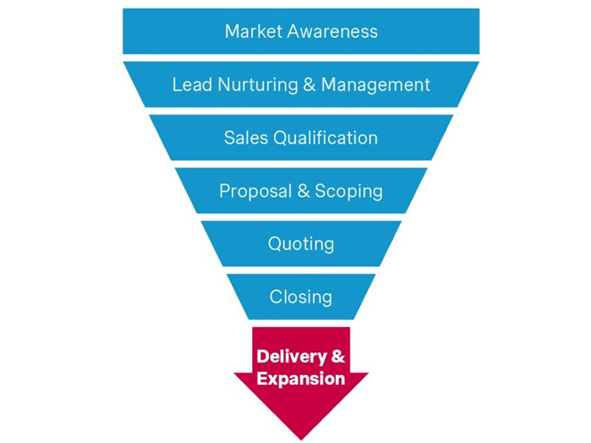
This final article looks at the post-sale stages, delivery, relationship management, expansion, and cross sell, and explains why great work still risks feeling replaceable unless its impact is obvious, continuous, and clearly linked to your company. We’ll cover practical ways to keep value visible, deepen stakeholder ties, and turn satisfied customers into loyal, growing accounts.
Delivery and relationship management: Good work doesn’t always mean memorable work
After the sale, your team shifts into delivery mode. However, if clients don’t clearly see the value that you’re delivering, they’ll start assuming it could be achieved elsewhere. And that perception doesn’t just affect satisfaction. It directly impacts renewals, referrals, and your ability to grow the account.
So, what should you do?
- Make your data their data. Give clients access to the numbers they care about, not just internal metrics. Let them slice and share results their way.
- Don’t wait for the Quarterly Business Review (QBR). Track and showcase impact in real-time. Dashboards, calculators, and quick-win summaries let clients see results as they happen.
- Treat QBRs as a strategic touchpoint. Run them consistently, with a clear structure and a focus on reinforcing outcomes. Use them as an opportunity to realign, reframe value, and shape what comes next.
- Invest in the relationship beyond the formal touchpoints. Use informal moments such as dinners, walks, or check-in’s outside the boardroom to build trust and reach new stakeholders. In professional services, the relationships that drive expansion often start outside the project scope.
- Expand your relationships beyond your initial contact. Use the delivery phase to expand your network within the organization and generate more contacts within the client organization.
In this market, delivery is about making sure that your value is obvious and that it’s associated with you, not just “good service”.
Learn to expand and cross-sell or they’ll try someone else next time
The downstream effects from AI show up most clearly when it comes time to expand and cross-sell. If your firm wasn’t clearly differentiated in earlier phases, clients are unlikely to come back. Even satisfied clients might say, “They were fine, but we might try someone else next time”. When switching costs feel low and your competitors are AI-enabled, cross-sell doesn’t just happen by default. It’s now become a battle for attention and trust. If you haven't built and strengthened the relationship by now, this is where it catches up to you.
Here’s how to keep the door open and ideally, widen it:
- Build triggers for cross-sell and expansion. Know the signals. Organizational changes, new budgets, and leadership transitions can be indicators that it’s time to re-engage.
- Enable your teams to act. Provide your delivery leaders (e.g., account executives and partners) with permission and tools to have the “what’s next” conversation early.
- Position your work as one piece of a bigger story. From the beginning, frame your engagement as a starting point, not the whole journey.
- Do a little free work. You’re already inside. Use what you’ve learned. Create a set of point of view or series insights the client didn’t ask for. Show them you’re thinking ahead. That small gesture is viewed as a gracious act and often wins the next project.
Expansion is a test of whether you stayed relevant after the contract was signed.
What AI really demands from your Go-to-Market strategy
AI hasn’t made professional services irrelevant, but it’s certainly changed how firms compete commercially. Clients expect clearer value and a sharper point of view on what sets you apart.
The companies that do best will be the ones that understand how to compete more effectively across every stage of the sales funnel and differentiate in the era of AI.
Here’s a quick recap of our recommendations to improve commercial success:
- Differentiate where it matters and build your commercial strategy around it.
Today, relevance is the ultimate differentiator. Leading companies are sharpening their go-to-market strategy by starting with commercial segmentation: identifying which types of clients they win with most often and at the best margins. From there, they tailor their positioning and offer packaging to highlight what sets them apart, specifically for those segments. Differentiation is about saying what matters, to the clients that matter.
- Rethink how content drives commercial outcomes.
Content still matters but only if it advances a sale. Professional services firms should shift from passive thought leadership to value-generating lead mechanisms: tools, frameworks, benchmarks, and diagnostics that help clients act, not just read. Measurement should shift from impressions to lead velocity, conversion, and client progression.
- Align pricing to what clients value and then, sell that value.
Now that AI compresses timelines and obscures effort, pricing based on inputs is increasingly difficult to defend. Progressive companies are shifting their commercial models, whether fixed-fee, tiered, or performance-based, to reflect client outcomes, strategic impact, and willingness to pay. But pricing logic alone isn’t enough. To make it stick, firms also need to equip their teams to sell that value, anchoring conversations in business impact, not deliverables, and reframing price as an investment in solving high-priority problems. It’s not just how you price, but how you justify, communicate, and defend the value behind it.
- Make value delivery visible, early and frequently.
In delivery, even high-impact work risks being forgotten if its value isn’t clearly demonstrated. Progressive companies are now building impact visibility into the client experience through structured check-ins, shared dashboards, usage metrics, and financial linkage. This strengthens renewal, expansion, and overall account performance.
- Actively manage your growth strategy and build the engine behind it.
Sustainable growth doesn’t happen by accident. It comes from treating growth like a core business function, with clear priorities, accountability, and execution discipline. Smart companies drive growth for their clients by helping identify real expansion potential and align teams around the highest-impact opportunities. That includes clarifying where to grow, what to sell, and how to operationalize it, so growth isn’t just hoped for but managed.
If any of this hits home and you’re looking for ways to sharpen your strategy, our team works with professional services companies to rethink how they differentiate, price, and grow in an AI-market. Reach out if you’d like to explore how we can help you unlock more meaningful, profitable growth.
Contributing author: Doga Sarier
Want to start from the beginning? Professional services and AI Part 1 of 4: TOFU